


You are doing everything you are supposed to do. Sunscreen every day. Gentle routine. A well-chosen active, introduced slowly. You have been patient. You have given it time.
And nothing is happening. Or it improved slightly and then stalled. Or it improved and then came back. Or it is slowly getting worse despite the consistency, which feels like the cruelest outcome of all.
The instinct at this point is to assume you need a stronger product, a more aggressive treatment, or a different active. Sometimes that is true. But more often, the reason pigmentation persists is not that the treatment is too weak. It is that something else is going on that the treatment was never designed to address.
What follows covers the five most common reasons hyperpigmentation resists treatment. Not to prescribe solutions, but to help you identify which factor is most likely at play so you know where to look next.
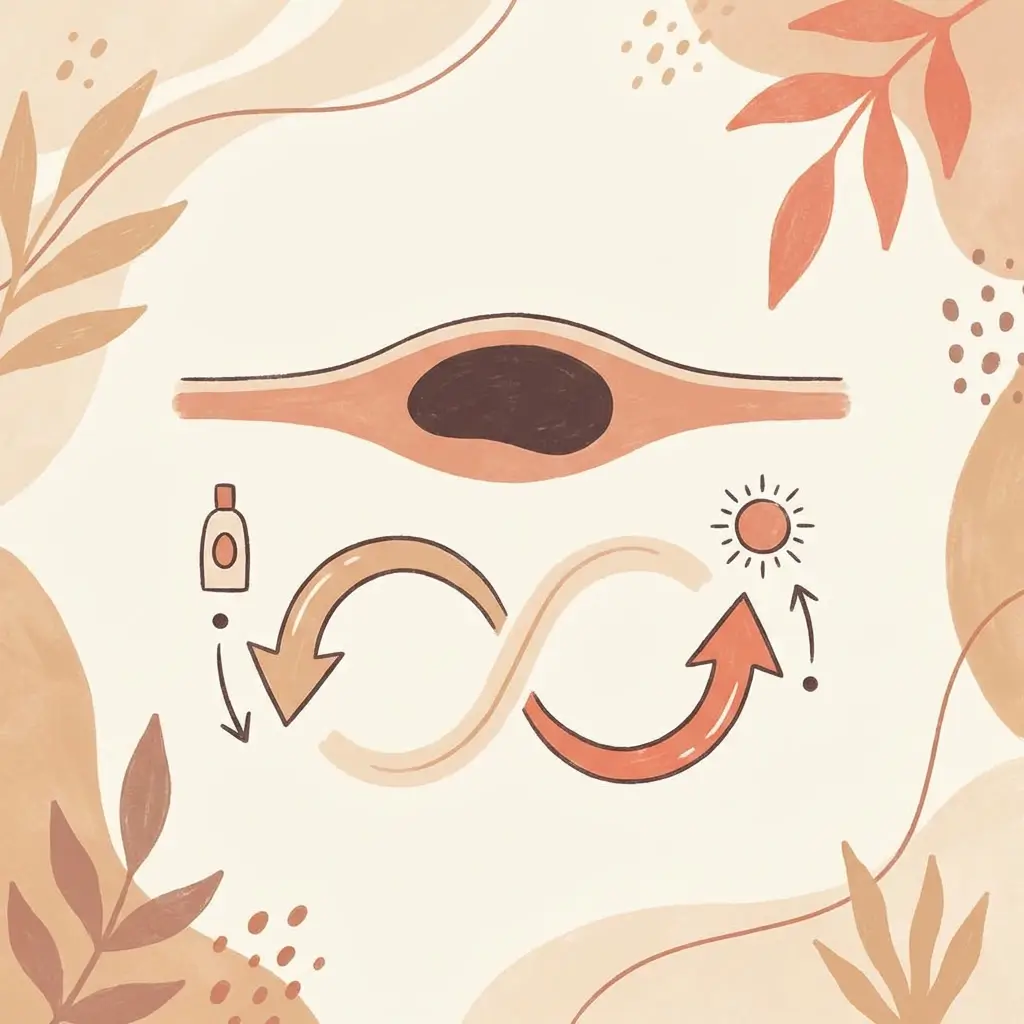
1. The trigger is still active
This is the most common reason and the one that gets missed the most.
Every type of hyperpigmentation has a cause. Something activated your melanocytes and told them to produce excess pigment. If that cause is still present, no treatment will outpace it. You are fading pigment with one hand and creating it with the other.
The obvious triggers are easy to identify. A breakout. A procedure. A sunburn. Those are discrete events with clear start and end points.
The triggers that keep pigmentation stubborn are the ones that do not feel like triggers because they are woven into daily life:
- A skincare routine that is causing low-grade irritation you have adapted to and no longer notice
- Friction from clothing, hair removal, or habitual touching in the same area
- Unprotected UV exposure that feels minor but is cumulative
- Heat exposure from cooking, exercise, or climate
- Ongoing hormonal input from contraception, HRT, or an undiagnosed hormonal condition
If your pigmentation is not responding, the first question is not "what should I add to my routine." It is "what is still feeding the pigmentation that I have not identified or removed." Hyperpigmentation causes covers these triggers individually and can help you trace the source.
2. The type has been misidentified
This happens more than people realise, and it changes everything about whether the treatment can work.
PIH, melasma, and sun spots are visually similar. They all present as dark patches on the skin. But they are driven by completely different mechanisms, and the treatment approach for each is fundamentally different.
A retinoid and tyrosinase inhibitor that steadily clears PIH can be completely ineffective for melasma, because melasma is not a turnover problem. It is a chronic hormonal and environmental feedback loop. The same retinoid might even make melasma worse if it causes irritation that feeds the cycle.
Sun spots are structural. The melanocytes themselves have been altered by years of UV exposure. They do not respond to the gentle topical approach that works for post-inflammatory marks, because the problem is not excess pigment lingering in the skin. It is a pigment-producing cluster that has been rebuilt to run permanently.
If you have been treating your pigmentation consistently for three to six months with an appropriate routine and seeing no improvement, one of the first things worth questioning is whether you are treating the right condition. Hyperpigmentation types can help you distinguish between them.
3. The pigment has dropped into the dermis
This is the factor that no amount of product can fully address, and understanding why requires knowing a small piece of skin anatomy.
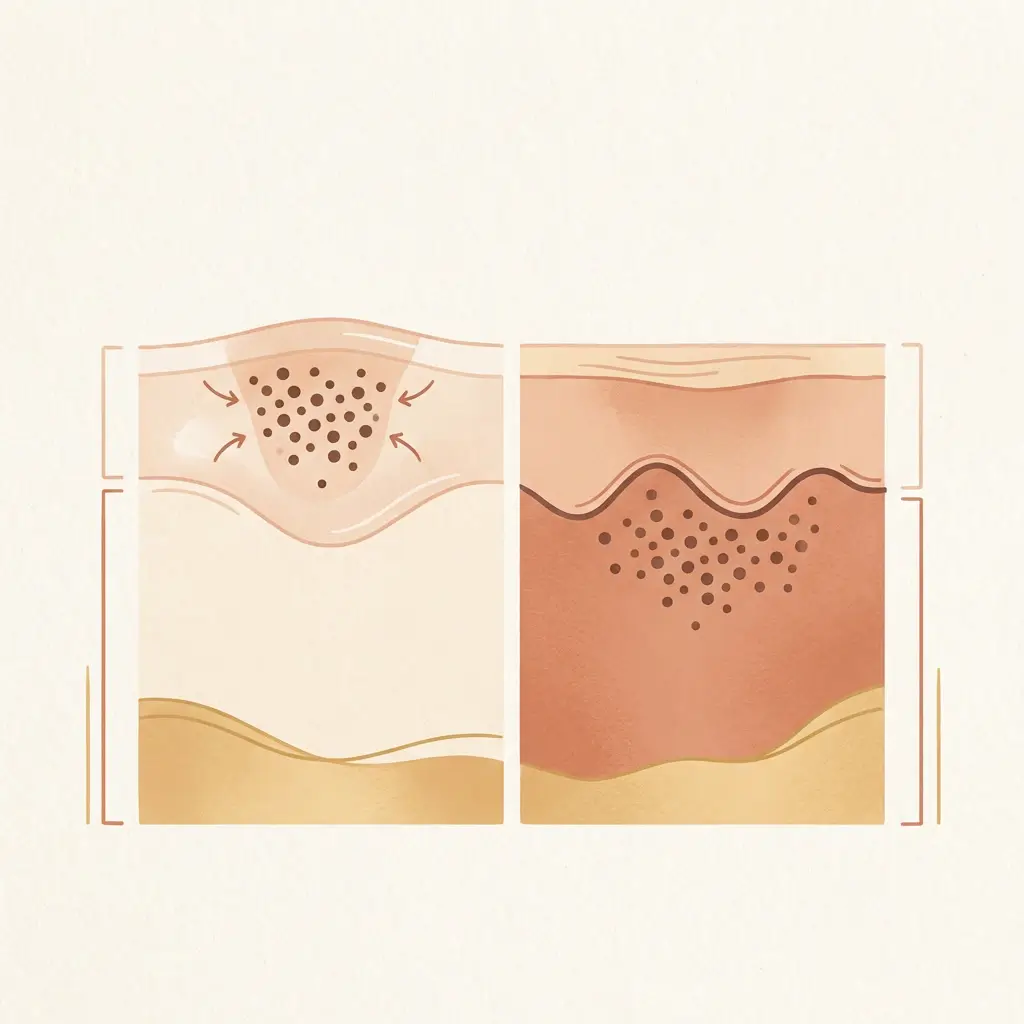
Your skin has two main layers. The epidermis is the outer layer, where most pigmentation sits. The dermis is the deeper layer beneath it. Between them is the dermal-epidermal junction.
Most topical treatments work within the epidermis. They accelerate the turnover of pigmented epidermal cells, inhibit the enzymes that produce melanin, or reduce the transfer of pigment between cells. When pigmentation is epidermal, this works. The pigmented cells are being produced, migrating to the surface, and shedding. Treatments that support or accelerate that cycle produce visible results.
But sometimes pigment drops below the epidermal layer into the dermis. This happens when inflammation is severe or prolonged enough to damage the dermal-epidermal junction, allowing melanin to fall through into the deeper tissue. Once it is there, it is no longer part of the normal turnover cycle. Dermal pigment is not being carried to the surface and shed. It is sitting in tissue that does not turn over the way the epidermis does.
Dermal pigment often has a blue-grey or slate-coloured appearance rather than the warm brown of epidermal pigmentation. That colour difference can help identify it, though the distinction is not always clear-cut, and some patches contain both epidermal and dermal components.
If your pigmentation has a blue-grey tone, has been present for a long time, and is not responding to topicals that should be working, dermal involvement is likely. A dermatologist can confirm this with a Wood's lamp examination. Dermal pigment may respond to certain laser treatments, but the expectations and timelines are different from epidermal pigmentation, and the approach needs to be adjusted accordingly.
4. Internal factors are contributing
This is the one most treatment guides skip entirely, and it is the one most relevant to the inside-out approach.
Your melanocytes do not operate in isolation. Their behaviour is shaped by your internal environment: systemic inflammation levels, oxidative stress, hormonal balance, nutrient status, blood sugar regulation, gut function, stress load, sleep quality.
When that internal environment is working against you, topical treatments hit a ceiling. They can address what is happening at the surface, but they cannot change the conditions that keep producing the problem. The pigment fades, then returns. Or it fades partially and stalls. Or it simply does not respond at the rate it should.
Internal factors are particularly likely to be involved when:
- Pigmentation is widespread or appearing in multiple areas without a clear external cause
- Treatment produces initial improvement that plateaus well short of full clearance
- Pigmentation seems to track with periods of stress, poor sleep, dietary changes, or hormonal shifts
- Co-occurring symptoms are present (fatigue, digestive issues, hair changes, cycle irregularities, energy crashes)
- The pigmentation pattern does not fit neatly into PIH, melasma, or sun spots
Hyperpigmentation from within covers these internal factors in detail: how stress and sleep, blood sugar, gut function, nutrient status, and thyroid function each interact with how your melanocytes behave.
5. The timeline is not what you expected
This one is not a biological problem. It is an expectations problem. But it is just as likely to derail treatment.
Pigmentation does not fade on a linear curve. It does not lighten by a predictable percentage each week. It fades unevenly, in stages, with periods of visible progress and periods where nothing seems to change. And the total timeline is almost always longer than people expect.
Rough benchmarks:
- Mild, recent PIH: 3 to 6 months of consistent treatment to see significant improvement
- Moderate, established PIH: 6 to 12 months
- Melasma: Ongoing management. Visible improvement within months, but maintenance is indefinite and flares are expected
- Sun spots with topicals only: Months to partial improvement. Full clearance often requires procedures
- Dermal pigment: 12 months or longer, often with procedural support
These are ranges under ideal conditions, meaning the trigger has been identified, the type is correct, sun protection is consistent, and no internal factors are working against you. If any of those variables are off, the timelines extend.
The risk of mismatched expectations is that impatience leads to premature escalation. You switch to a stronger product. You add another active. You book a procedure too early. And the escalation introduces irritation or inflammation that sets you back further than patience would have.
How to use this
These five factors are not mutually exclusive. More than one can be present at the same time, and often is. Stubborn pigmentation is frequently the result of two or three factors compounding each other: a trigger that has not been fully removed, an internal factor that is elevating the baseline, and a timeline that was never realistic for the type being treated.
The value of working through this list is not arriving at a single diagnosis. It is narrowing the field. If you can identify which of these factors is most likely relevant to your situation, you know where to focus your attention and which part of the guide will be most useful.
- If the trigger may still be active: start with Hyperpigmentation causes
- If you are not sure of the type: start with Hyperpigmentation types
- If internal factors may be involved: explore Hyperpigmentation from within
- If the timeline may be the issue: revisit Hyperpigmentation treatments for your specific type
The answer to stubborn pigmentation is almost never "try harder with the same approach." It is "figure out what the approach is missing."
The most effective treatment adjustment is often not a new product. It is a better understanding of what you are actually dealing with.


