


Treating melasma like a sun spot is one of the most expensive mistakes in skincare. Not because the products are wrong, but because the biology is different in every way that matters: different triggers, different depth, different relapse patterns, different treatment tolerance. A strategy that fades one type can actively worsen another.
That is why identification comes first. Before the serum, before the procedure, before the routine. If the type is wrong, the plan is wrong, and everything downstream costs time and sometimes makes the original problem harder to resolve.
Most pigmentation advice skips this step entirely or reduces it to a single line ("identify your type") without explaining what that actually means or why two similar-looking marks can behave in completely opposite ways.
Why correct identification changes everything
The reason type matters so much is that hyperpigmentation is not one condition. It is a category containing several distinct biological patterns, each with its own triggers, its own depth profile, and its own rules for how it responds to treatment.
Post-inflammatory hyperpigmentation is a scar-like response to a specific event. Melasma is a chronic signalling pattern driven by hormones, heat, and light. Sun spots are the cumulative result of decades of UV exposure. They look similar on the surface. Underneath, they have almost nothing in common.
This matters practically because the wrong identification leads to the wrong treatment intensity, the wrong active ingredients, and the wrong expectations. Melasma treated with aggressive exfoliation or high-heat lasers frequently rebounds worse than before. PIH treated as melasma often gets an unnecessarily cautious approach that delays progress. Sun spots treated as PIH sit there unchanged while someone waits for fading that will never happen on its own.
The confusion costs time, money, and confidence. Getting the type right is the single most important thing you can do before spending anything on treatment.
The four markers that separate types
Dermatologists classify pigmentation using a combination of visual and contextual cues. You do not need clinical equipment to use the same logic. Four markers do most of the work.
Symmetry and pattern. Where the pigment sits and whether it mirrors itself across both sides of the face. Perfect bilateral symmetry, especially across the cheeks, forehead, and upper lip, points strongly toward a hormonal or systemic driver. A mark that appears at one specific site points toward an event-driven response.
Trigger profile. What was happening when the pigment appeared or worsened. After a breakout or injury? After pregnancy or a contraceptive change? After years of sun exposure with no single triggering event? The trigger history narrows the field more reliably than the visual appearance alone.
Depth clues. Colour carries information about where the melanin is sitting. Brown and tan tones suggest epidermal pigment, in the upper layers where turnover can move it out. Blue-grey, ashy, or muted tones suggest dermal pigment, deeper in the skin where it is cleared by a much slower immune-mediated process. Depth determines how quickly something can realistically fade and which treatments can reach it.
Relapse behaviour. Some types fade and stay faded once the trigger is resolved. Others return with seasonal changes, hormonal shifts, or heat exposure regardless of what treatment was used. Understanding the relapse profile before starting treatment prevents the frustration of watching results disappear and assuming the approach failed when, in reality, the type simply requires ongoing management.
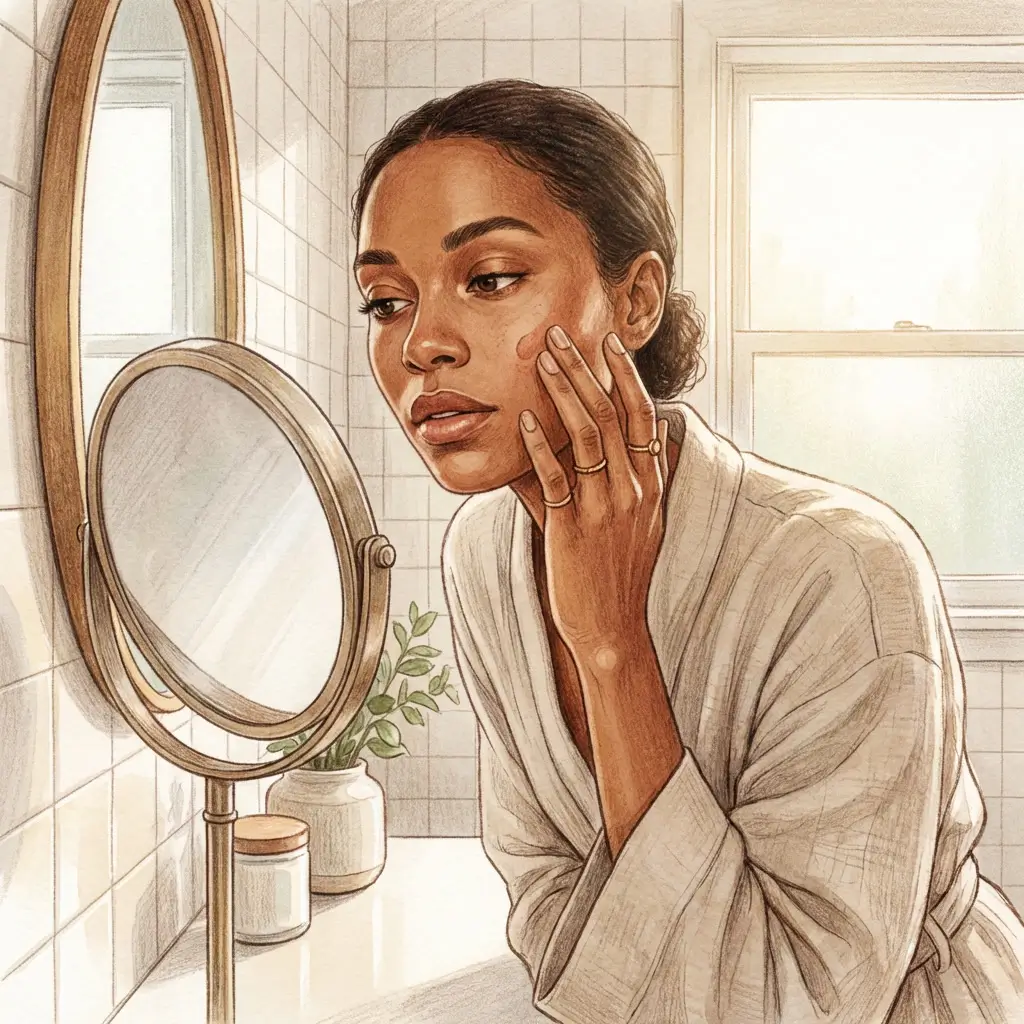
Identify your pattern
Match your skin's behaviour to the closest description below. If more than one fits, that is common. Start with the one that feels most dominant.
- "I have a symmetrical 'mask' on my forehead, cheeks, or upper lip" → Melasma
- "A dark mark appeared exactly where a pimple or injury used to be" → Post-Inflammatory Hyperpigmentation (PIH)
- "I have scattered, distinct brown spots on sun-exposed areas" → Sun Spots (Solar Lentigines)
- "I have small, flat pigment dots that deepen with sun exposure" → Freckles
- "I have constant dark circles or shadowing under my eyes" → Periorbital Pigmentation
- "Pigment appeared or worsened after heat, procedures, or irritation" → Heat-Triggered Pigmentation or Post-Procedure Pigmentation
- "I have dark, velvety patches in skin folds (neck or armpits)" → Acanthosis Nigricans
- "Pigment changed colour or distribution after starting a medication" → Medication-Related Pigmentation
If none of these match clearly, the comparison guides below help distinguish between the types most commonly confused with each other.
Hyperpigmentation types
Core types
Each covers what the type looks like, where it appears, what triggers it, how it behaves over time, how deep it typically sits, its relapse risk, and when to see a dermatologist. No treatment recommendations here. Treatment lives hyperpigmentation treatments
Post-inflammatory hyperpigmentation is the most common type. A dark mark left behind after inflammation: acne, eczema, a bite, a burn, a procedure. It appears at the exact site of the original event. Colour ranges from pink-red to deep brown depending on skin tone and whether pigment has stayed in the epidermis or dropped into the dermis. It usually fades if the triggering inflammation stops, but "usually" hides a lot of variation. → Post-Inflammatory Hyperpigmentation (PIH)
Melasma is symmetrical, patch-like, and driven by a fundamentally different mechanism. Hormonal signalling, UV, visible light, and heat all contribute, and they stack. It appears on the forehead, cheeks, upper lip, and jawline. It is chronic, relapse-prone, and often deeper than it appears. Every meaningful clinical parameter, triggers, depth, relapse risk, treatment tolerance, differs from PIH. Treating them the same way is the most consequential misidentification in pigmentation care. → Melasma
Sun spots (solar lentigines) are flat, distinct, well-defined brown marks on chronically sun-exposed skin: face, hands, chest, shoulders. They are the result of cumulative UV damage over years, not a single event. They are generally stable and slow-changing. They do not fade on their own without intervention, which is one of the clearest ways to distinguish them from PIH. → Sun Spots (Solar Lentigines)
Freckles are small, flat, genetically influenced pigment dots that darken with sun and may lighten in winter. They are not damage. The confusion with sun spots is worth resolving because the two are managed very differently: freckles fluctuate seasonally and tend to appear in childhood, while sun spots are larger, stable, and accumulate over decades. → Freckles
Periorbital pigmentation is persistent darkening under and around the eyes, and it is one of the most misidentified presentations in dermatology. The same appearance can be caused by genetics, thin skin showing vasculature, allergic inflammation, actual melanin deposition, or volume loss creating shadow. Often it is not true hyperpigmentation at all, which is why topical brightening products frequently do nothing for it. → Periorbital Pigmentation
Heat-triggered pigmentation appears or worsens specifically after heat exposure without an obvious procedure or inflammatory event. Saunas, hot kitchens, hot climates, hot yoga. Heat activates melanocytes through vascular and inflammatory pathways that have nothing to do with UV. This is one of the most under-recognised triggers, and it is frequently missed as the reason pigment keeps returning despite good sun protection. → Heat-Triggered Pigmentation
Post-procedure pigmentation is a form of PIH where the triggering inflammation came from a clinical procedure: lasers, peels, microneedling, dermabrasion. The mechanism is the same, but the context is different. A clinical setting, a provider's responsibility, a recovery protocol. It is separated because the conversation around it is different: when to contact your provider, whether the darkening is expected, and how long to wait before deciding something went wrong. → Post-Procedure Pigmentation
Higher-risk patterns
These patterns may indicate something beyond cosmetic hyperpigmentation. Each covers what to look for, when to see a doctor, and what questions to ask.
Medication-related pigmentation involves colour changes triggered by specific medications: minocycline, antimalarials, certain chemotherapy agents, psychiatric medications, oral contraceptives. The pigment is often blue-grey and appears in distributions that do not match other types. The first step is identifying the association. The second is knowing what to ask your prescriber. → Medication-Related Pigmentation
Acanthosis nigricans presents as dark, velvety, thickened patches in skin folds: neck, armpits, groin, under the breasts. It is often a sign of insulin resistance or metabolic dysfunction rather than a cosmetic pigment issue. This is not something to treat with topicals. It is something to investigate with blood work. → Acanthosis Nigricans
Comparison guides
These help you distinguish between the types that are most commonly confused. Each covers visual differences, trigger differences, depth and behaviour differences, and what to do if you have been treating the wrong one.
- PIH vs Melasma: The most common and most consequential misidentification. Treating melasma like PIH (aggressive exfoliation, strong acids) risks inflammatory rebound. This confusion costs people more time and money than any other.
- PIH vs Sun Spots: Both can appear as brown marks on the face. The difference: PIH fades over time if the trigger stops. Sun spots do not budge without intervention. Trigger history is the main differentiator.
- PIH vs Freckles: Relevant for people with lighter skin who see scattered pigment after breakouts. Freckles are genetic, uniform, and fluctuate with sun. PIH is site-specific and tied to a triggering event.
- PIH vs Post-Procedure Pigmentation: Important after clinical treatment. The key question: is this expected post-procedure darkening that will resolve, or has the procedure caused new PIH? Knowing the difference changes whether you wait or act.
- Melasma vs Sun Spots: Both appear on sun-exposed areas of the face. Melasma is symmetrical, diffuse-edged, and reactive. Sun spots are distinct, well-defined, and stable. Different triggers, different behaviour, different treatment requirements.
- Melasma vs Heat-Triggered Pigmentation: Heat is a known melasma trigger, but heat-triggered pigmentation can also occur without the hormonal component. The overlap is real, which is exactly why this distinction matters.
- Sun Spots vs Freckles: Common confusion in lighter skin. Freckles are smaller, uniform, appear in childhood, and fluctuate with seasons. Sun spots are larger, stable, and develop with cumulative exposure over decades.
Common identification mistakes
Treating melasma like PIH. This is the mistake with the biggest downstream cost. Aggressive exfoliation, friction from scrubbing, high-strength acids. PIH can tolerate more intensity. Melasma cannot. It reads that intensity as a new trigger and responds with rebound darkening that is harder to resolve than the original patch.
Ignoring symmetry. If pigment mirrors itself across both sides of the face, that is a strong signal of a hormonal or systemic driver rather than localised damage. The treatment implications are significant: symmetrical patterns usually need trigger management as a long-term discipline, not just a topical fading plan.
Confusing redness with pigment. Pink or red marks left after acne are post-inflammatory erythema (PIE), which is vascular, not melanin-driven. PIE responds to completely different interventions. Applying brightening actives to a vascular mark does nothing except irritate skin that is already healing. Hyperpigmentation vs Redness covers how to tell these apart.
Assuming under-eye darkness is hyperpigmentation. Periorbital darkening has multiple causes, and actual melanin deposition is only one of them. Thin skin, visible veins, volume loss, and allergic inflammation can all create the same appearance. Treating a structural shadow with a brightening serum is not going to produce results.
Overlooking body folds. Dark, velvety patches on the neck, armpits, or groin are rarely cosmetic hyperpigmentation. Acanthosis nigricans is a metabolic signal, and the appropriate response is blood work, not skincare products.
Where to go next
Understand why your pigment appeared. Once you know the type, the triggers behind it determine what needs to change. The Causes section covers every major driver, from UV and heat to hormones, inflammation, and internal factors.
See how skin tone changes the picture. Melanin-rich skin responds faster and more intensely to triggers, which changes both identification and treatment decisions. Hyperpigmentation and Skin Tone covers what most advice overlooks.
Explore treatment options. The Treatments section covers topicals, procedures, prescriptions, and internal support, organised by treatment role and by pigment type so you can match the approach to what you have identified here.
Check your timeline expectations. Fading timelines vary dramatically by type and depth. The Timeline section sets realistic benchmarks so you know whether your progress is on track or something needs adjusting.
FAQ
How do I know what type of hyperpigmentation I have?
Use four markers: symmetry and pattern (is the pigment mirrored across the face or localised to one spot?), trigger profile (what was happening when it appeared?), depth clues (brown suggests epidermal pigment, blue-grey suggests dermal), and relapse behaviour (does it stay faded or return with triggers?). The symptom router above matches common presentations to their most likely type.
What is the difference between melasma and sun spots?
Melasma is symmetrical, patch-like, and reactive to hormones, heat, and light. It has diffuse edges and fluctuates. Sun spots are distinct, well-defined marks from cumulative UV exposure over years. They are stable and do not change with hormonal shifts. Melasma needs ongoing trigger management. Sun spots respond well to targeted treatment without the same relapse risk. Comparison goes deeper.
Can I have more than one type of hyperpigmentation at the same time?
Yes, and it is common. Someone with melasma on the cheeks can also have PIH from acne on the chin and sun spots on the temples. Each type still follows its own rules. The treatment plan needs to account for the most reactive type present, which is usually melasma, because an approach that is too aggressive for one type can worsen the others.
Why does my pigmentation keep coming back after treatment?
The most likely reason is that the underlying trigger is still active. Treatment cleared the visible pigment, but the signal telling melanocytes to produce was never switched off. This is especially common with melasma (where hormonal, heat, and light triggers persist) and with PIH where the original inflammatory condition has not been controlled. The type determines the relapse profile, which is why identification matters before treatment begins.
Are dark circles under the eyes a type of hyperpigmentation?
Sometimes, but often not. Periorbital darkening can result from actual melanin deposition, thin skin showing underlying blood vessels, volume loss creating shadow, or allergic inflammation. Many people apply brightening products without results because the cause is structural rather than pigmentary. Periorbital pigmentation covers how to tell which mechanism is likely driving your presentation.