


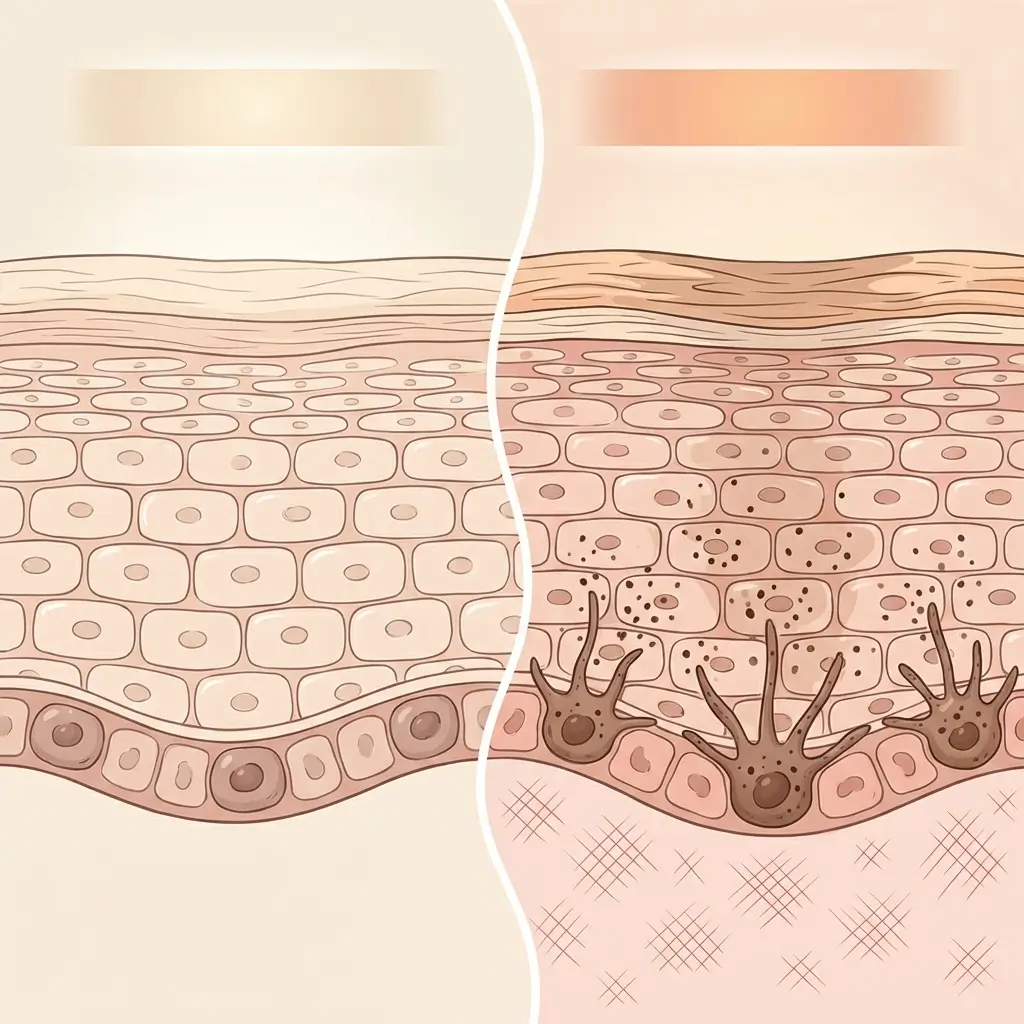
Here is the good news about PIH: of all the types of hyperpigmentation, it is one of the most responsive to treatment. The pigment is usually in the epidermis, your skin is already trying to shed it through normal cell turnover, and with the right approach, you are working with your biology rather than against it.
Here is the part that most treatment guides get wrong: they jump straight to topical actives. Layer this serum. Add this acid. Introduce a retinoid. And if that does not work fast enough, escalate to a peel or a laser.
That approach is not wrong exactly, but it is incomplete. It only addresses what is happening at the surface. It ignores the internal environment driving melanocyte behaviour in the first place. And for the women most likely to struggle with PIH, particularly those with melanin-rich or reactive skin, an active-heavy topical approach can create the very irritation and inflammation that keeps the cycle going.
What follows is the full treatment approach. Not just what to put on your skin, but how to support the process from the inside, what order to do it all in, and what to avoid.
Step 1: Stop the inflammation that started it
This is the step that gets skipped the most, and it is the most important one.
PIH exists because inflammation activated your melanocytes. If the source of that inflammation is still present, no treatment will outpace it. You will be fading pigment with one hand and creating it with the other.
Before you add anything to your routine, ask whether the trigger has actually resolved:
- If the PIH came from acne, is the acne under control? Not just the big breakouts, but the low-level congestion and irritation that keeps the skin in a mildly inflamed state.
- If it came from an irritating product or routine, has that product been removed? Has the skin had time to calm down?
- If it came from a procedure, has the healing window fully closed?
This is not a waiting period for the sake of patience. It is a biological prerequisite. Melanocytes that are still receiving inflammatory signals will keep producing excess pigment regardless of what you layer on top.
Step 2: Sun protection, every day, no exceptions
You already know sunscreen matters. But with PIH specifically, it is not just good practice. It is the single biggest factor in whether your treatment actually works.
UV exposure stimulates melanocytes directly. If you are treating PIH without rigorous sun protection, UV is reactivating the very cells you are trying to calm down. Every study on every treatment for pigmentation, topical or internal, shows dramatically better results when combined with consistent broad-spectrum sunscreen. Without it, even effective treatments underperform or fail entirely.
This means SPF 30 or higher, broad-spectrum, reapplied during the day, every day, including overcast days and days spent mostly indoors near windows. It also means considering physical barriers (hats, positioning, shade) in high-UV situations.
It is not glamorous. But nothing else you do will work properly without it.
Step 3: Support the process from the inside
This is the piece that most treatment guides either skip entirely or mention as an afterthought. And it is the piece that, in our experience, makes the biggest difference to whether the results last.
Your melanocytes do not operate in isolation. Their behaviour is shaped by your internal environment: oxidative stress levels, systemic inflammation, nutritional status, hormonal balance. When that internal environment is working against you, surface treatments are fighting uphill. They can fade what is already there, but they cannot change the conditions that keep producing it.
Supporting the process internally means giving your body the raw materials it needs to regulate melanocyte activity, manage inflammation from the inside, and support healthy skin cell turnover so pigmented cells clear efficiently.
This is the thinking behind our Hyperpigmentation Cleanse Capsules. They are designed to work on the internal drivers that topicals cannot reach: antioxidant support to reduce the oxidative stress that triggers melanocytes, anti-inflammatory compounds that help calm the signalling cascade at its source, and nutrients that support the skin's natural renewal cycle. Not as a replacement for what you do on the surface, but as the foundation underneath it.
Think of it this way. Topicals work on the pigment that is already there. Internal support works on the environment that decides whether more keeps coming.

Step 4: Topicals, chosen carefully and introduced slowly
Topicals have a real role in PIH treatment. The question is which ones, and how aggressively you introduce them.
This is where a lot of women with reactive or melanin-rich skin run into trouble. The standard advice is to layer multiple actives: a tyrosinase inhibitor, a retinoid, an exfoliating acid, a vitamin C serum. On paper, each one makes sense. In practice, stacking them creates a cumulative irritation load that can push already-sensitive melanocytes right back into overdrive. The treatment becomes the trigger.
The better approach is to start minimal and build slowly.
Where to start
- Tyrosinase inhibitors slow down the enzyme that produces melanin. Well-tolerated options include azelaic acid, arbutin, kojic acid, tranexamic acid (topical), and niacinamide. These are a sensible first topical layer because they target the mechanism directly without heavy irritation risk.
- Niacinamide is worth highlighting because it works differently. It does not slow melanin production. It reduces the transfer of pigment from melanocytes to surrounding cells. It is also anti-inflammatory, which makes it especially useful when you are trying to keep the whole area calm.
If you need more after 8 to 12 weeks
- Retinoids (retinol, adapalene, tretinoin) accelerate cell turnover, helping the skin shed pigmented cells faster. They are effective, but they are also the most common source of treatment-induced irritation. If your skin is reactive, a gentler retinol may be smarter than jumping to prescription tretinoin. Start low, increase slowly, and watch for signs that the skin is reacting rather than responding.
- Vitamin C (L-ascorbic acid) inhibits tyrosinase and provides antioxidant protection. It works best at 10 to 20 percent concentration. It can sting on sensitised skin, so pay attention to how yours handles it.
Prescription options for stubborn PIH
- Hydroquinone is the strongest topical tyrosinase inhibitor. It works, but it comes with guardrails: typically limited to 8 to 12 week cycles, and prolonged use can cause a paradoxical darkening called ochronosis. This is a targeted tool for resistant pigment, not a starting point.
For a deeper comparison of specific ingredients, see the OTC Topicals.
The key principle across all of these: if a topical is causing visible irritation, redness, stinging, or peeling that does not settle within a week or two, it is creating inflammation. And inflammation is what caused the PIH in the first place. More is not better. Tolerated is better.
Step 5: Procedures, only when the groundwork is done
Procedures (chemical peels, microneedling, laser treatments) can accelerate PIH clearance beyond what topicals and internal support achieve alone. But they should come last in the sequence, not first, and they carry their own pigmentation risk.
The principle is straightforward: a procedure adds controlled inflammation to your skin. If the skin is already stabilised, protected, and supported internally, it can handle that inflammation and benefit from it. If the skin is still reactive, under-protected, or fighting unresolved inflammation from the original trigger, a procedure adds fuel to a fire that has not gone out yet.
When the timing is right:
- Superficial chemical peels (mandelic, lactic, low-strength glycolic) are the most conservative option. They boost cell turnover in a controlled way and carry the lowest pigment risk.
- Microneedling can help break up pigment deposits and distribute its injury across many tiny channels, making it generally lower risk than concentrated treatments.
- Laser treatments (particularly non-ablative, low-fluence devices) can target pigment more directly, but carry the highest risk of post-inflammatory hyperpigmentation, especially in darker skin.
For a detailed comparison, see Lasers vs. Peels.
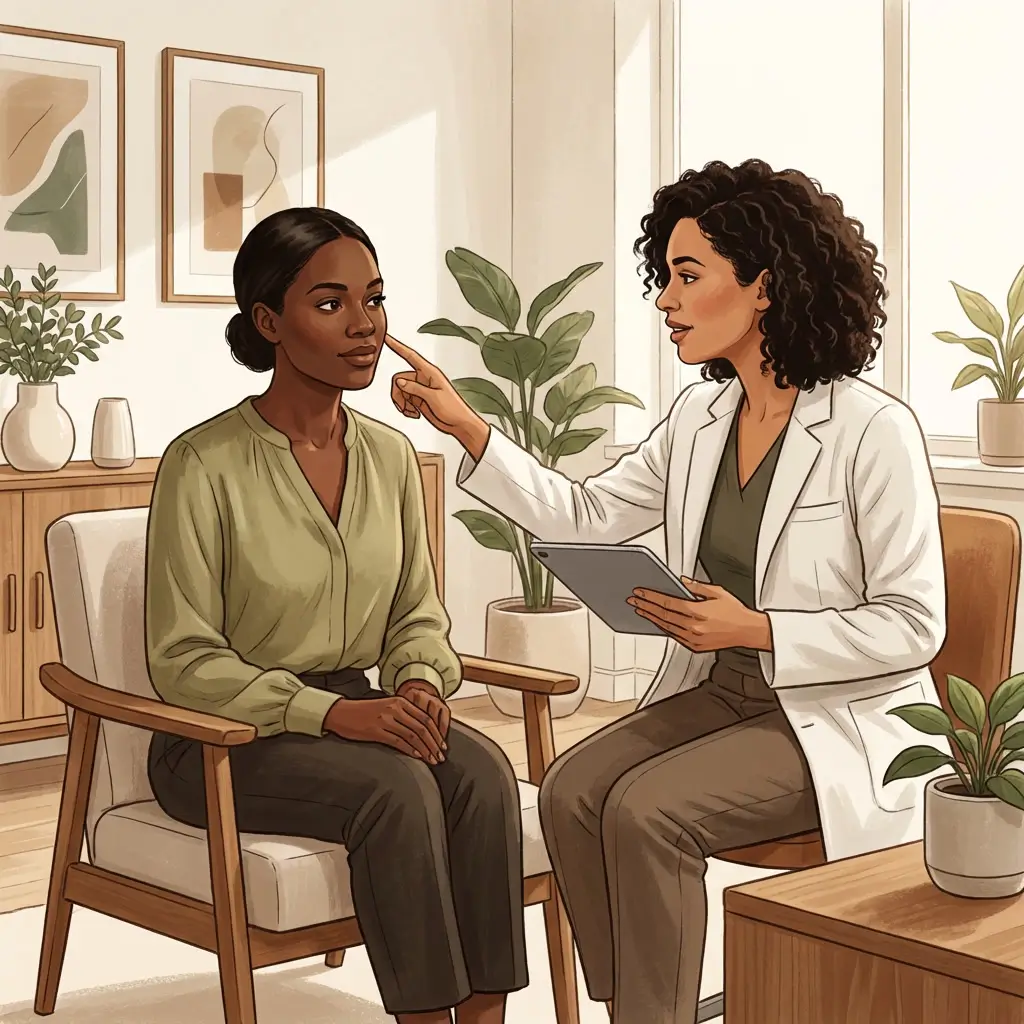
The more melanin in your skin, the more conservative the procedure should be, and the more critical it is that your provider has genuine experience calibrating for melanin-rich skin tones.
What to avoid
Some things that seem like they should help with PIH can actually set you back, especially if your skin is reactive or melanin-rich.
- Stacking multiple actives at once. Retinoid plus vitamin C plus an AHA plus niacinamide, all introduced in the same week. The cumulative irritation can restart the pigment cycle you are trying to end.
- Harsh physical exfoliants. Scrubs, rough washcloths, aggressive buffing. Mechanical irritation triggers inflammation. That is the opposite of what you need.
- High-strength acids without building up. A 30% glycolic peel on skin that has never used an AHA is not a shortcut. It is an injury.
- Skipping sunscreen because you are "mostly indoors." UV passes through windows. Even low-level exposure reactivates melanocytes mid-treatment.
- Procedures too early. If the skin has not been stabilised and prepped, a peel or laser can create a new wave of PIH on top of what you were already treating.
- Ignoring the internal side. Treating PIH only from the outside is like mopping a floor while the tap is still running. You can see results, but they are harder to maintain if the internal drivers are still active.
The common thread: anything that creates inflammation in the area you are treating is working against you.
Realistic timelines
PIH treatment is not fast. Setting honest expectations upfront saves frustration and prevents the impulse to escalate too soon.
- Mild, recent PIH (light brown marks from a breakout a few weeks ago) can respond to a combination of sun protection, internal support, and gentle topicals within 3 to 6 months.
- Moderate, established PIH (darker marks, months old, repeated in the same area) typically takes 6 to 12 months of consistent treatment to see significant improvement.
- Deep or dermal PIH (blue-grey tones suggesting pigment has dropped below the epidermis) is slower and more resistant. It may take 12 months or longer and may benefit from procedural support alongside internal and topical treatment.
These are ranges, not guarantees. Skin tone, pigment depth, sun exposure habits, internal health, and whether the original trigger is truly resolved all affect the pace.
The marks did not appear overnight. They will not disappear overnight. But PIH is one of the types that genuinely does respond, and a steady, well-sequenced approach that works from the inside out gives you the best odds of results that actually last.
The full sequence
If you take one thing from this, let it be this: the order matters more than the individual products.
- Resolve the inflammation source.
- Establish consistent sun protection.
- Support the process internally.
- Introduce gentle, well-tolerated topicals. Give them time.
- Layer in stronger actives only if needed, slowly.
- Consider procedures only after the skin is stable and in experienced hands.
The standard approach starts at step 4 and works backward when things go wrong. This approach starts where the biology starts and builds outward from there.
PIH is frustrating, but it is not permanent and it is not untreatable. The mistake most people make is not choosing the wrong product. It is treating only the surface and wondering why the results do not hold.


