


If you have been treating melasma the same way you would treat dark spots from a breakout, and it is not getting better or keeps coming back, there is a reason for that. Melasma is a fundamentally different condition, and treating it like PIH is one of the most common ways women end up in a worse position than where they started.
PIH is pigment left behind by a resolved injury. Melasma is pigment driven by an ongoing internal process. That distinction changes everything about how you approach it.
With PIH, you are clearing something that has already happened. With melasma, you are managing something that is still happening. The triggers are often hormonal, they are influenced by UV and heat, they are affected by your internal environment, and they do not switch off just because you started a treatment. Which means the treatment strategy has to account for all of that, not just the pigment you can see.
We cover how to approach melasma treatment realistically. What works, what does not, why aggressive approaches backfire, and what maintenance actually looks like long term.
Why melasma plays by different rules
Most hyperpigmentation follows a simple pattern: something injures or inflames the skin, melanocytes react, pigment is produced, the trigger resolves, and the pigment gradually fades.
Melasma does not follow that pattern.
With melasma, the melanocytes are being driven by signals that are systemic, not local. Hormonal fluctuations (pregnancy, oral contraceptives, HRT), UV exposure, heat, and internal inflammatory and oxidative stress all feed into a loop that keeps melanocytes in a state of chronic overactivity. The trigger is not a single event. It is an ongoing conversation between your hormones, your environment, and your skin.
This means:
- Clearing the visible pigment does not resolve the underlying condition. The melanocytes can reactivate.
- Anything that adds inflammation to the skin (aggressive actives, harsh procedures, irritating routines) does not just risk new pigment. It feeds the existing cycle.
- UV and heat are not just risk factors. They are active, ongoing triggers that can undo weeks of progress in a single afternoon.
- Internal factors matter more here than in almost any other type of hyperpigmentation, because the drivers are systemic.
If you take nothing else from this, take this: melasma treatment is not about attacking the pigment. It is about calming the system that produces it and then carefully, gently encouraging what is already there to clear.
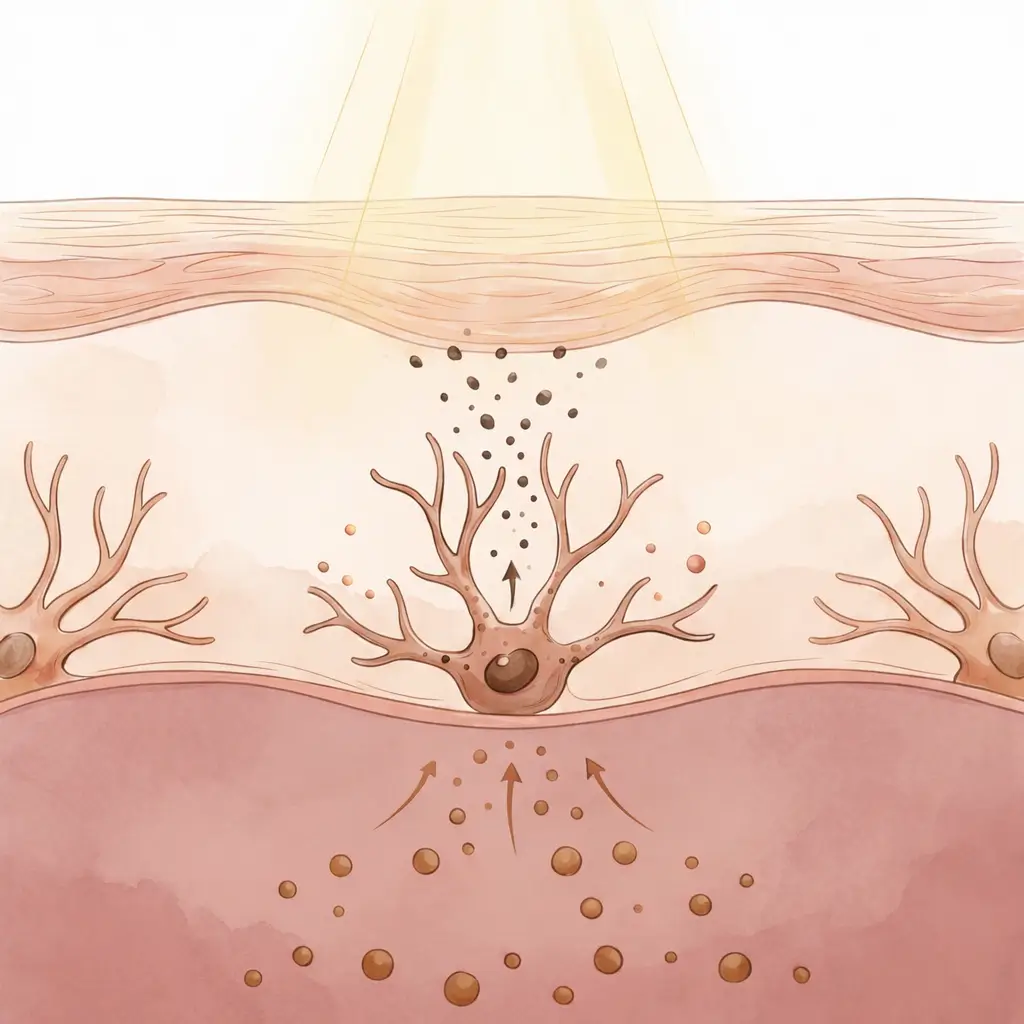
Step 1: Trigger control
With PIH, the trigger is usually in the past. With melasma, it is usually in the present. That makes trigger control the foundation of treatment, not a preliminary step you complete and move on from, but an ongoing discipline that runs underneath everything else.
UV protection
This goes beyond what you might be doing for general skin health. Melasma melanocytes are hypersensitive to UV, and even small, incidental exposures can reactivate pigment in areas you have spent months clearing.
- SPF 30 or higher, broad-spectrum, reapplied every two hours during any sun exposure.
- Tinted sunscreens containing iron oxide are worth considering. Visible light (the kind your phone and overhead lights emit, but more significantly the kind that comes through windows and off reflective surfaces outdoors) can trigger melasma, and iron oxide blocks visible light in a way that standard UV filters do not.
- Physical barriers: hats, positioning, shade. These are not optional extras for melasma. They are part of the treatment.
Heat
This is the trigger most people do not know about. Heat independently stimulates melanocytes, even without UV. Saunas, steam rooms, hot yoga, cooking over a stove for extended periods, intense exercise in direct sun. If you have noticed your melasma darkening after heat exposure even when you were diligent about sunscreen, this is likely why.
Hormonal triggers
If your melasma coincides with oral contraceptives, hormonal therapy, or pregnancy, the hormonal component is almost certainly a driver. This does not always mean stopping medication, that is a decision for you and your doctor, but it does mean understanding that as long as the hormonal trigger is active, treatment is managing the condition rather than resolving it. Being clear about that upfront saves a lot of frustration.
Step 2: Support the process from the inside
Melasma is driven by systemic signals. Oxidative stress, internal inflammation, and hormonal fluctuations all feed into melanocyte overactivity. Treating melasma only from the surface leaves these deeper drivers untouched.
This is where internal support plays a larger role than in almost any other type of hyperpigmentation. The goal is to address the conditions that keep melanocytes reactive: reducing oxidative stress, calming systemic inflammation, and supporting the nutritional foundations that your skin needs to regulate pigment production and turn over cells efficiently.
Our Hyperpigmentation Cleanse Capsules are formulated to work at this level, targeting the internal signalling pathways that topicals cannot reach. The full formulation breakdown and the evidence behind each ingredient category is on the supplements page. Topicals and trigger control manage what is happening at the surface and the environment. Internal support works on the underlying conditions that keep the cycle active.

Step 3: Topicals, but with a very different mindset
Topicals have a role in melasma treatment, but the approach is almost the opposite of what works for PIH. With PIH, you are trying to accelerate clearance. With melasma, you are trying to suppress ongoing production without triggering the reactivity that makes it worse.
That means gentler formulations, slower introduction, and a much lower tolerance for irritation. If a topical is causing redness, stinging, or peeling that does not settle quickly, it is adding inflammation. And in melasma, inflammation is not just a side effect. It is a driver.
What works
- Tranexamic acid (topical or oral) has become one of the most important tools in melasma treatment. It works by interrupting the interaction between keratinocytes and melanocytes, reducing the signals that drive pigment production. It is generally well tolerated and does not carry the irritation risk of many other actives. Oral tranexamic acid, used under medical supervision, has shown particularly strong results for melasma, though it requires monitoring.
- Azelaic acid (15 to 20 percent) inhibits tyrosinase, is anti-inflammatory, and is one of the better-tolerated options for melanin-rich and reactive skin. It does not carry the same rebound risk as hydroquinone.
- Niacinamide reduces melanin transfer and calms inflammation. It is not the most powerful brightening agent on its own, but it makes everything else work better and does not irritate.
- Hydroquinone is effective for melasma but requires careful management. It is typically used in cycles of 8 to 12 weeks with breaks in between, because prolonged use risks ochronosis (a paradoxical darkening). It is a targeted intervention, not a maintenance product.
What to be careful with
- Retinoids can help with melasma by increasing cell turnover, but they are a double-edged sword. The irritation they cause, especially at higher strengths or when introduced too fast, can trigger a melasma flare. If you use one, start at the lowest effective strength and increase very slowly. Many women with melasma find that their skin simply does not tolerate retinoids well, and that is a valid reason not to push it.
- High-strength AHAs and BHAs. Exfoliating acids can support turnover, but in melasma-prone skin, the irritation risk is real. Low concentrations, infrequent use, and careful monitoring are the approach. Not daily actives at aggressive percentages.
- Vitamin C can be helpful as an antioxidant and mild tyrosinase inhibitor, but high-concentration L-ascorbic acid formulations at low pH can sting and irritate sensitised skin. If it is causing discomfort, it is not helping.
For a deeper look at specific ingredients and tolerability, see the OTC Topicals.
Step 4: Procedures, and why less is more
This is the area where the most damage gets done in melasma treatment. Procedures that work well for PIH or sun damage can be genuinely harmful for melasma, because the mechanism is different and the melanocytes are more reactive.
What can help, used conservatively
- Superficial chemical peels (low-strength lactic, mandelic, or modified Jessner's) can gently enhance turnover and improve topical penetration. They should be mild, spaced well apart, and performed by someone who understands melasma specifically.
- Microneedling at conservative depths can support product delivery and collagen remodelling without creating significant inflammation. But depth, frequency, and what is applied during and after matter enormously.
- Low-fluence, non-ablative laser (such as Q-switched Nd:YAG at 1064nm in "laser toning" mode) has shown some benefit for melasma, but results are inconsistent, rebound hyperpigmentation is a real risk, and it requires a provider with specific melasma experience. This is not a first-line treatment. It is a last-resort option after conservative approaches have been fully explored.
What to avoid
- Ablative lasers. CO2, erbium. The inflammatory load is too high. Melasma rebound after ablative laser treatment is well documented and can be severe.
- IPL (Intense Pulsed Light). Despite being marketed for pigmentation, IPL is poorly suited to melasma. It can initially lighten the pigment but frequently triggers a rebound that is darker than the original.
- Medium to deep chemical peels. TCA at higher concentrations, deep phenol peels. The injury is too aggressive for melasma-prone skin. The inflammatory response can trigger a flare that erases months of progress.
- Aggressive microneedling. Deep needling, too many passes, potent serums applied to open channels. What would be moderate for PIH treatment can be too much for melasma.
For a detailed comparison of procedural options, see Lasers vs. Peels.
The principle to hold onto: melasma melanocytes are reactive. They are looking for reasons to fire. Every procedure adds some degree of inflammation, and the threshold at which that inflammation triggers a rebound is lower than you might expect. Conservative, spaced, and monitored is the only approach that makes sense.

The maintenance reality
This is the part that matters most.
Melasma is a chronic condition. It can be managed, improved, and controlled. But in most cases, it does not fully resolve and stay gone the way PIH eventually can. The melanocytes retain a kind of memory. They have been activated by hormonal and environmental signals for so long that they remain primed to reactivate, even after the visible pigment has cleared.
What this means practically:
- Treatment is not a phase you complete. It is a baseline you maintain. Sun protection, trigger management, and internal support are not things you do until the melasma fades and then stop. They are ongoing.
- Flares will happen. A summer holiday, a hormonal shift, a stressful period, a few days of skipped sunscreen. The pigment can return. This is not a failure of treatment. It is the nature of the condition.
- The goal shifts over time. Early on, the goal is improvement. Long term, the goal is stability. Keeping the melasma managed, keeping flares short and mild, and maintaining the internal and external conditions that keep melanocytes quiet.
Women who do best with melasma long term are the ones who accept this framework early. Not because it is what they want to hear, but because it lets them build a sustainable routine rather than chasing a cure, getting frustrated, and escalating to treatments that make things worse.
Melasma management is not a sprint. It is a way of caring for your skin that accounts for how your skin actually works.
The full approach
- Trigger control. UV protection (broad-spectrum, iron oxide, physical barriers), heat awareness, and honest assessment of hormonal drivers. This is not a step. It is the permanent foundation.
- Internal support. Address the oxidative stress, inflammation, and nutritional gaps that keep melanocytes reactive from the inside.
- Gentle topicals. Tranexamic acid, azelaic acid, niacinamide. Introduced slowly, monitored for irritation. Hydroquinone in cycles if needed under supervision.
- Conservative procedures only if needed. After the skin is stable. With an experienced provider. Spaced and monitored. Never aggressive.
- Ongoing maintenance. Sun protection, internal support, and a minimal topical routine that keeps the system calm, indefinitely.
The approach that holds up over time is the one that starts from the inside, protects the surface, adds actives only as tolerated, and respects the fact that melasma is a condition you manage, not a stain you remove.


