


The routine was supposed to fade the dark marks. The acids were supposed to accelerate turnover. The exfoliant was supposed to clear the surface. And for a while, maybe it looked like it was working.
Then the skin started stinging when it did not sting before. Products that were fine two months ago now burn on contact. The texture changed. The redness spread. And the pigmentation, the thing the routine was built to fix, got darker.
This is one of the most common and least discussed patterns in hyperpigmentation treatment. You did not do something careless. You did what the products and the content told you to do. You layered actives. You exfoliated consistently. You added a retinoid on top of an acid on top of a vitamin C. And the skin's barrier could not sustain it.
What you are dealing with now is not a pigmentation problem. It is a barrier problem that is making the pigmentation worse. The order of operations matters here more than anywhere else: this is a repair job before it is a fading job.
What Happened
The skin barrier is a functional structure. It holds moisture in, keeps irritants out, and regulates how the skin responds to the environment. When it is intact, active ingredients can do their work without provoking a defensive response. When it is damaged, everything changes.
Over-exfoliation strips the outer layers faster than the skin can rebuild them. Acid overuse disrupts the lipid matrix that holds the barrier together. Retinoids at too-high a concentration or introduced too quickly accelerate turnover beyond what the barrier can support. Combining multiple actives without adequate spacing compounds the damage.
The result is skin that is thinner, more permeable, and chronically inflamed at a low level. That inflammation is not dramatic enough to look like a rash or a burn. It is subtle, persistent, and exactly the kind of inflammatory signal that stimulates melanocytes.
In darker skin tones (Fitzpatrick IV to VI), melanocytes are more reactive to these signals. The pigment response is often disproportionate to the visible damage. A few weeks of over-exfoliation can produce marks that last months.
The pigmentation did not darken because the products were too weak. It darkened because the barrier broke, the skin became inflamed, and the inflammation drove new melanin production on top of the old. The treatment became the trigger.
Step One: Stop
This is the hardest step because it feels like going backwards. Stopping the actives that were supposed to be fixing the problem feels like giving up on the problem. It is not.
Stop all actives. All of them.
No acids (glycolic, lactic, mandelic, salicylic). No retinoids (tretinoin, retinol, adapalene). No vitamin C at high concentration. No exfoliating toners. No brightening serums. No chemical or physical exfoliants.
The skin cannot repair its barrier while it is being continuously stripped. Every active applied to a damaged barrier is an irritant. Every irritant provokes inflammation. Every inflammatory event stimulates melanocytes. The cycle does not break until the input stops.
Sun protection stays. A gentle cleanser stays. A basic moisturiser stays. Everything else comes off the shelf until the barrier has recovered.
This is not a two-day reset. It is a commitment measured in weeks.
If your barrier seems to break down repeatedly despite careful routines, the vulnerability may not be entirely surface-level. The From Within section covers what influences barrier resilience systemically.
Step Two: Repair
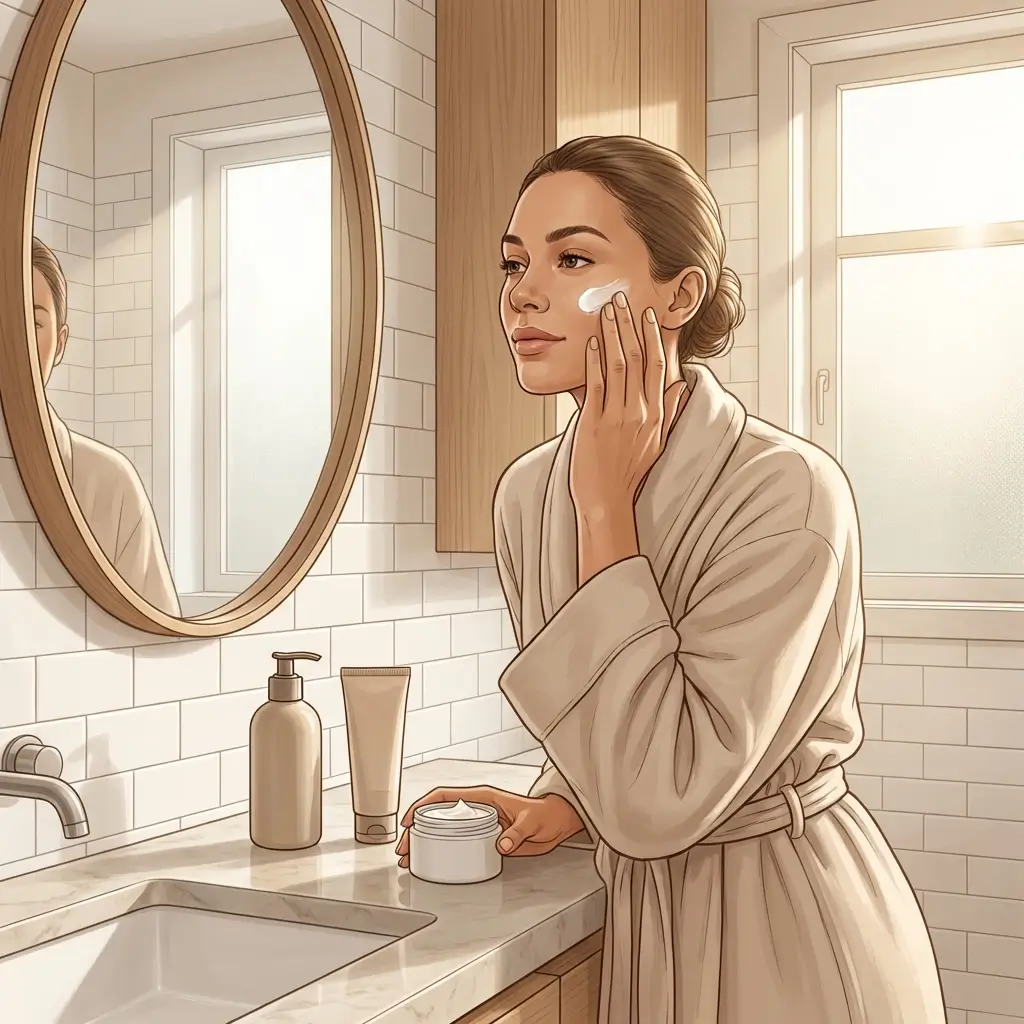
Once the actives have stopped, the barrier needs to be actively supported. It will rebuild on its own if left alone, but supporting the process shortens the timeline and reduces the low-grade inflammation that is sustaining the pigmentation.
Ceramides are the primary structural lipid in the skin barrier. A ceramide-rich moisturiser directly supplies what the barrier has lost. This is not a luxury step. It is the most functionally specific thing you can do for barrier recovery.
Hyaluronic acid draws moisture into the upper layers and supports hydration while the barrier is compromised. It is not repairing the barrier itself, but it creates the conditions in which repair happens more efficiently.
Those two form the core. Everything else in this phase is about not interfering.
Gentle, non-foaming cleansers prevent further stripping. If the cleanser leaves the skin feeling tight after rinsing, it is too harsh for a compromised barrier. Switch to something that feels like it did almost nothing. That is what repair-phase cleansing should feel like.
Avoid anything with fragrance, essential oils, or alcohol during this phase. The barrier is permeable. Ingredients that would not normally cause irritation can reach deeper layers and provoke a response. Sensitivity during this phase is not the skin being difficult. It is the barrier being open.
This phase typically lasts four to eight weeks. The signs that it is working are subtle: the stinging stops, the redness calms, products no longer burn on contact. The skin starts to feel like skin again rather than something raw and reactive.
If the damage is severe, persistent, or accompanied by pain, a dermatologist can prescribe barrier-repair protocols that go beyond what over-the-counter products can achieve. Used appropriately, these interventions can significantly accelerate recovery.
There is no shortcut.
Step Three: Wait
This is the step most people skip.
The barrier feels better. The stinging has stopped. The instinct is to reintroduce the actives immediately. Too early.
A barrier that has stopped stinging is not the same as a barrier that has fully recovered. The surface may feel normal while the deeper lipid structure is still rebuilding. Reintroducing actives at this point risks re-damaging a barrier that was almost there, resetting the clock, starting the cycle again.
Wait at least two weeks after the skin feels fully normal before reintroducing anything. That buffer is not wasted time. It is insurance against a relapse that would cost more time than it saves.
The Internal Layer
Barrier repair is nutrient-intensive. The skin rebuilds its lipid matrix using ceramides, fatty acids, and cholesterol, and the synthesis of these components depends on systemic availability of the raw materials. Zinc, essential fatty acids, and vitamin A all play documented roles in barrier function and repair.
This is a different mechanism from the internal layer in other parts of this guide. For melasma, the internal goal is influencing how reactive your melanocytes are. For UV-driven pigmentation, it is antioxidant capacity. Here, it is supplying what the skin needs to physically reconstruct its barrier. The faster and more completely the barrier rebuilds, the sooner the low-grade inflammation resolves, and the sooner the pigmentation stops being actively worsened.
Kallistia's internal support is formulated around this specific bottleneck: the antioxidant and anti-inflammatory precursors that barrier reconstruction draws on systemically. For barrier damage, this is less about pigment regulation and more about giving the rebuilding process what it needs to actually complete.

Step Four: Reassess the Pigmentation
Once the barrier is intact, look at the pigmentation again.
Some of what appeared to be stubborn pigmentation was actually inflammation. Chronic low-grade redness and irritation can make marks appear darker and more extensive than the actual melanin deposits underneath. With the barrier repaired and the inflammation resolved, the remaining pigmentation may be lighter and less widespread than expected.
This is the point to decide what the pigmentation actually needs. It may be mild enough that a gentle maintenance routine is sufficient. It may still warrant active treatment. But the treatment plan should be built for the skin as it is now, not for the skin that was inflamed and reactive two months ago.
Step Five: Reintroduce Carefully
The actives that damaged the barrier were not necessarily wrong. They may have been right products at wrong concentrations, in wrong combinations, or at the wrong pace. At the right concentration and pacing, these ingredients can be genuinely effective. The goal is not to avoid them permanently. It is to reintroduce them in a way the barrier can sustain.
One active at a time. Not two. Not a "simplified" routine of three actives instead of five. One.
Start with the gentlest option. Niacinamide at 5% is the safest re-entry point: it supports the barrier, reduces melanin transfer, and carries almost no irritation risk. Use it for two to three weeks. If the skin tolerates it without any return of stinging, tightness, or increased sensitivity, the barrier is holding.
After that, the next active depends on the pigmentation. A low-concentration vitamin C or azelaic acid for melanin suppression. A gentle AHA once or twice a week for turnover. A low-strength retinoid on alternate nights. Not all of these. The next one that the skin needs most. Two weeks minimum between each new addition.
If anything provokes stinging or redness, remove it and wait. The barrier is telling you where the limit is. The routine that caused the damage was probably too many actives at too-high concentrations introduced too quickly. The rebuild should be the opposite of that in every way.
For ingredient detail and sequencing beyond this re-entry phase, OTC Topicals covers the full picture.
What Not to Do
- Do not "push through" the stinging. Stinging on a compromised barrier is not the product working. It is the product reaching layers it should not reach. Continuing deepens the damage and worsens the pigmentation.
- Do not add more products to fix the problem that products caused. The instinct to find a new serum that will repair the barrier while also fading the marks is the same instinct that created the problem. The barrier needs less, not more.
- Do not use heavy occlusives on actively irritated skin without checking tolerance. They can trap irritants against a compromised barrier. If the skin is still stinging, start with a simple ceramide moisturiser alone.
- Do not assume the barrier is healed because the surface feels smooth. Give it the 2-week buffer after symptoms resolve before reintroducing actives.
For more on how treatments create the opposite of their intended effect, see Why Some Treatments Make Pigment Worse.
The Takeaway
The hardest part of this process is accepting that the pigmentation cannot be actively treated right now. The marks are visible. The urge to do something about them is real. And the answer, for now, is to do less.
The barrier has to come first. Without it, every active is an irritant, every irritant is an inflammatory trigger, and every inflammatory trigger makes the pigmentation worse. The cycle only breaks when the input stops.
Repair the barrier. Wait longer than feels necessary. Reassess. Reintroduce slowly. The pigmentation will still be there when the skin is ready to treat it. And the skin will respond to treatment far better when it is intact than it ever did when it was compromised.


