


Post-inflammatory hyperpigmentation is probably the most common type people deal with, and the good news is that it has one of the more favourable prognoses. Breakout clears, mark appears, mark fades over time. That is the general arc. But "over time" can mean anywhere from a few weeks to well over a year, and the difference comes down to a handful of variables that most people never think to assess.
Why PIH timelines vary so much
Not all PIH is the same mark in a different location. The depth of the pigment deposit, how inflamed the original trigger was, how long the inflammation lasted, and your natural melanin density all influence how quickly the mark resolves. A shallow mark from a mild breakout on lighter skin can fade in four to six weeks with no intervention at all. A deep mark from a cystic breakout on melanin-rich skin can take six months to a year even with consistent treatment.
The key variable is depth. Epidermal PIH sits in the upper layers of your skin and gets carried out through normal cell turnover. That is the pigment that responds well and fades with time and basic care. Dermal PIH happens when melanin drops below the basement membrane and gets trapped in macrophages in the dermis. That pigment is not part of the turnover cycle anymore and cannot be pushed out the way epidermal pigment can.
You can get a rough sense of where your PIH sits by colour. Brown and dark brown marks tend to be epidermal. Grey or blue-grey marks tend to be dermal. But the overlap is real, especially on darker skin tones, so if you are not sure, a dermatologist with a Wood's lamp can tell you in a few minutes.
What to expect at each stage
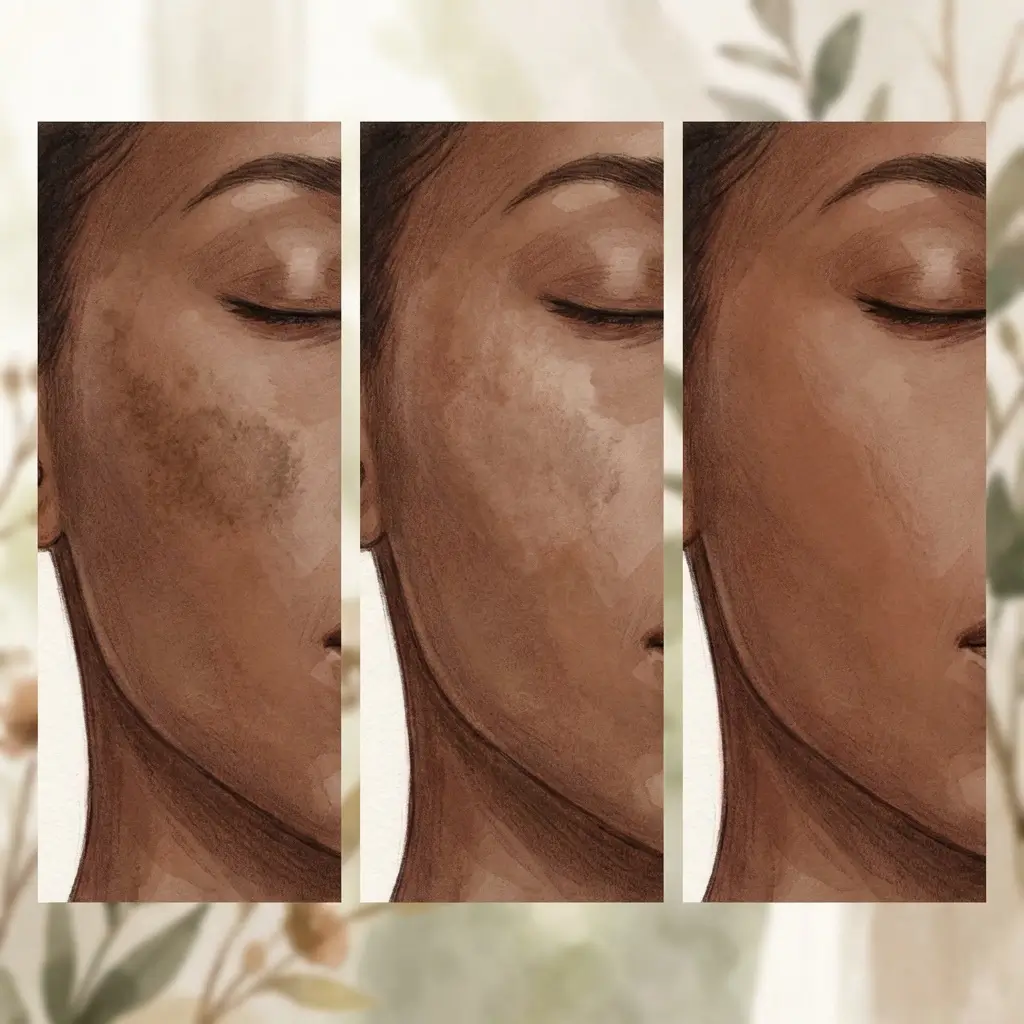
Weeks 1 to 4: The quiet phase. The original trigger (breakout, burn, irritation) has resolved, but the mark looks exactly the same. This is normal. Your skin is doing the work of calming the inflammatory signalling and beginning to turn over the pigmented cells, but none of that is visible yet. Unless the mark is getting darker or expanding, you are on track.
Weeks 4 to 8: Early shift. Surface-level PIH should start showing subtle changes. The colour may look slightly less saturated, the edges may soften, or the mark may look different in certain lighting. This is the stage where comparison photos matter because day-to-day changes are too gradual to register in the mirror. If you are not seeing any shift at all by week eight, that is worth noting but not panicking about. Deeper PIH simply takes longer to surface.
Months 2 to 4: Visible fading. For most epidermal PIH, this is the window where progress becomes unmistakable. The mark is noticeably lighter, smaller, or both. If you have been consistent with sun protection and gentle support, the trajectory should feel encouraging here. This is also the window where the temptation to escalate or add more products hits hardest. Resist it. What is working is working. Let it continue.
Months 4 to 8: Continued resolution or stall point. Shallow PIH may be fully resolved by now. Deeper marks are still fading but more slowly, and this is where patience gets tested the most. If the mark has been steadily improving, stay the course. If it has completely stalled with no change for eight or more weeks, it is time to reassess whether the pigment has a dermal component.
Beyond 8 months: Any PIH that has not meaningfully improved after eight months of consistent, well-matched care likely involves dermal pigment or an unresolved underlying factor. Professional assessment is the logical next step. The stubborn pigmentation guide can help identify what might be holding things back.
What influences PIH speed
Depth of the original inflammation. A surface-level breakout leaves a surface-level mark. A deep cystic lesion or a burn that went through multiple layers of skin deposits melanin deeper and leaves a mark that takes proportionally longer to resolve.
Whether the trigger has actually stopped. PIH fading cannot outrun an active trigger. If the breakouts are still happening, the skin is still being inflamed, and new pigment is being deposited while old pigment is trying to clear. Trigger resolution is the foundation. Everything else layers on top of that.
Skin tone. Melanin-rich skin produces more pigment in response to inflammation, and that pigment tends to be deposited more densely and sometimes deeper. This does not mean the prognosis is worse. It means the timeline is longer and the approach needs to be more patient and more careful.
Sun and heat exposure. UV and heat reactivate melanocytes. Even pigment that is actively fading can stall or darken again with unprotected exposure. This is the single most common reason people feel like their PIH treatment "stopped working."
Barrier health. If your skin barrier is compromised from over-exfoliation or harsh actives, your skin is in a low-grade inflammatory state that feeds right back into pigment production. Sometimes the fastest way to speed up PIH fading is to stop doing so much.
The difference between fresh PIH and established PIH
Fresh PIH is a mark that appeared in the last few weeks. The inflammation may have just resolved, the melanin deposit is recent, and the skin's natural turnover has not had time to move it out yet. Fresh PIH has the best prognosis because the pigment is usually still epidermal and the inflammatory signalling is recent enough that the body is already in the process of clearing it.
Established PIH is a mark that has been sitting there for months or longer. The longer pigment stays, the higher the chance some of it has migrated into the dermis. Established PIH can still fade, but it often takes longer, responds less to topicals alone, and may benefit from professional support.
The practical difference is that fresh PIH often resolves with trigger removal, sun protection, and time. Established PIH more frequently needs active support, and the approach needs to be matched to the actual depth of the pigment, not just the surface colour.
When PIH resolves on its own vs when it needs help
Mild, epidermal PIH from a minor breakout or surface irritation will often resolve on its own within a few months as long as the trigger has stopped and the skin is being protected from UV. Your body is designed to clear this pigment. It is a normal part of the healing process.
PIH that benefits from intervention includes marks that are deep in colour, marks from severe inflammation, marks that have been present for several months without improvement, and marks on melanin-rich skin where the inflammatory response deposited more pigment than the body can efficiently clear on its own. Internal support that addresses the residual inflammatory signalling beneath the surface can make a meaningful difference in how fast the body resolves what is left.
The mark is temporary. How temporary depends on where it sits and what's still driving it underneath.


