


If you have brown or dark skin and you've been consistent with sunscreen but your pigment still isn't budging, the problem might not be what you're doing wrong. It might be what your sunscreen isn't blocking.
Standard sunscreens filter ultraviolet radiation. They do that well. But visible light, the light you can actually see, passes straight through them. For lighter skin, that's not a meaningful pigment trigger. For melanin-rich skin, it is. And that gap between what your sunscreen covers and what your skin responds to could be the reason your results have stalled.
Your skin responds to light your sunscreen doesn't cover
For a long time, UV was considered the only light-based pigment trigger. Visible light was treated as irrelevant. That's changed.
Research now shows that visible light, particularly in the blue-violet range (sometimes called HEV or high-energy visible light), can trigger melanin production in darker skin through a pathway that's completely independent of UV. It works through melanopsin, a light-sensitive receptor in skin cells that responds to visible wavelengths and signals your melanocytes to produce pigment.
What makes this matter is how the pigment behaves. Visible light-triggered pigment in melanin-rich skin tends to be darker, deeper, and more persistent than UV-triggered pigment. It's not that the exposure is more damaging. It's that your melanocytes respond through a different route, and the pigment it produces is harder to shift.
This response scales with melanin. People with lighter skin show minimal to no visible light-triggered pigment. The response becomes meaningful in medium-dark tones and is strongest in brown and dark skin. Same room, same screen, same window, entirely different impact on your pigment.
If you've felt like your skin plays by different rules than what most advice accounts for, this is one of the reasons why.
Where the exposure adds up
The biggest source of visible light is sunlight. Even on overcast days when UV drops, the visible light component stays high. That means days when you'd expect less pigment risk can still carry real exposure for your skin.
Indoor sources matter too, but in a different way. Office lighting, screens, and home lighting are all lower intensity than sunlight. The issue is duration. Eight hours under fluorescent lights or in front of a screen adds up, not because any single moment is significant, but because the accumulation over a full day is.
Screens have gotten a lot of attention, and the reality is more nuanced than the headlines suggest. Your phone at arm's length isn't the primary concern. The bigger picture is total visible light from all sources throughout the day, with sunlight as the dominant one and indoor sources layering on top.
The practical point: if you're spending your days near windows, under bright office lighting, or on screens for hours, your melanocytes are receiving visible light signals that your sunscreen isn't addressing.
Tinted sunscreen is the fix
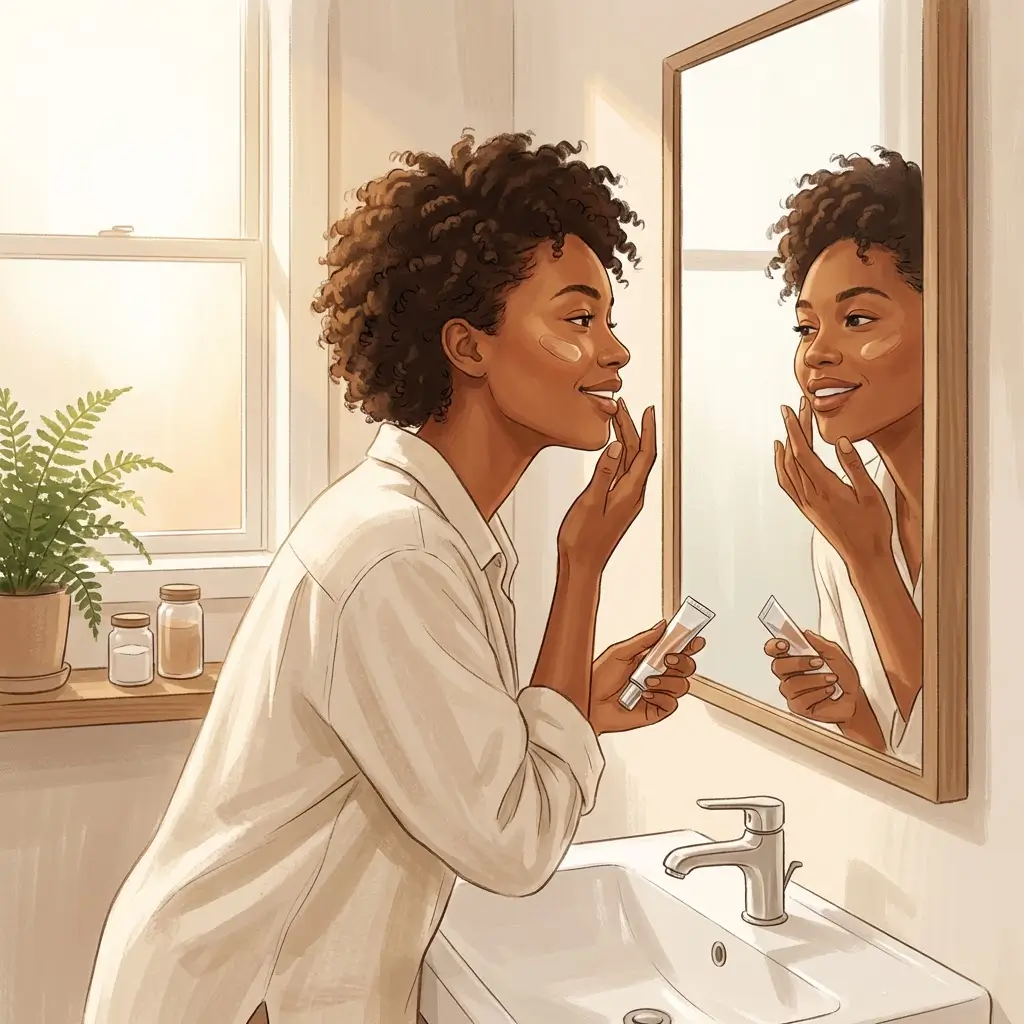
This is where it gets actionable. The most effective way to block visible light is with iron oxides, mineral pigments that absorb across the visible light spectrum. Iron oxides are what give tinted sunscreens their colour.
A tinted sunscreen with iron oxides gives you UV protection from the active filters and visible light protection from the iron oxides. For melanin-rich skin, that combination addresses both triggers at once.
This isn't a cosmetic preference. It's a functional upgrade that closes a real gap in your protection. The tint needs to contain actual iron oxides, not just cosmetic colouring. Check the ingredients for iron oxides (CI 77491, CI 77492, CI 77499) to confirm.
For people with brown and dark skin managing active hyperpigmentation, switching from untinted to tinted iron-oxide sunscreen is one of the most impactful single changes available. It won't resolve existing pigment on its own, but it stops a trigger that may have been quietly undermining everything else you're doing.
If you've been frustrated watching someone with lighter skin use the same sunscreen and see their marks fade while yours hold, this is often a big part of why. Your protection needs to cover a wider range of light than theirs does. Once it does, the rest of your routine has a better chance of working.
Why some people's skin overreacts to the same light
Two people with similar skin tones can sit in the same room and see different pigment outcomes. Part of that comes down to what's happening internally.
When background inflammation is already elevated, from stress, poor sleep, blood sugar instability, or nutritional gaps, your melanocytes are already running in a more reactive state. They don't need as strong a signal to ramp up pigment production. The same visible light exposure that one person's skin handles without issue can keep another person's pigment active because the internal environment is already primed.
This is why tinted sunscreen alone doesn't always close the gap completely. It blocks the external trigger, but if the internal signals keeping your melanocytes reactive aren't addressed, your skin can still overrespond to whatever light does get through. The protection layer and the internal layer work together. One without the other leaves part of the problem running.
What to adjust
For brown and dark skin, "sun protection" means something broader than SPF. It means UV protection plus visible light protection. A few shifts make that practical:
Tinted sunscreen with iron oxides as your daily baseline. Not an occasional add-on. For active pigment, this applies on indoor days and overcast days too.
Think total light exposure, not just screen time. Sunlight is the dominant source. Indoor lighting and screens add up through duration. Reducing brightness and increasing screen distance helps at the margins, but it's not the main lever.
Window film for high-exposure spaces. If you work near a window for hours daily, blue-light-filtering window film reduces one of the sustained sources.
The core change is simple: your skin responds to a wider range of light than standard sunscreen covers. Tinted sunscreen with iron oxides closes that gap. For many people with brown and dark skin, that one adjustment is what unlocks the progress everything else has been working toward.


