


If you have brown or dark skin and you've noticed that areas where clothing, bra straps, or skin folds create pressure have gradually become darker than the surrounding skin, you're looking at one of the most common and least discussed forms of hyperpigmentation.
It's not sun damage. It's not a product reaction. It's your skin responding to repeated friction with a protective melanin response. And it will persist for as long as the friction continues, which is exactly what makes it so frustrating. You can't always avoid the source.
How friction triggers darkening
The skin's response to repeated friction is a form of chronic low-grade inflammation. Each point of contact creates a small signal. Individually, each one is negligible. But when the same area is subjected to friction day after day, the accumulated pressure triggers melanocytes to produce extra melanin.
In lighter skin, that response is mild. In brown and dark skin, where melanocytes are larger and more reactive, the output is much larger. The result is visible darkening at friction points that deepens progressively over weeks and months. It tends to be diffuse rather than sharply defined, and it often has a slightly different texture from the surrounding skin.
Where it shows up
The sources are often so built into daily life that you don't think of them as a trigger:
- Bra straps and underwire. Darkening along the shoulders, ribcage, and under the breasts that matches the exact contour of the garment.
- Waistbands and belts. A band of darkening around the waist and hips from pants, skirts, and underwear.
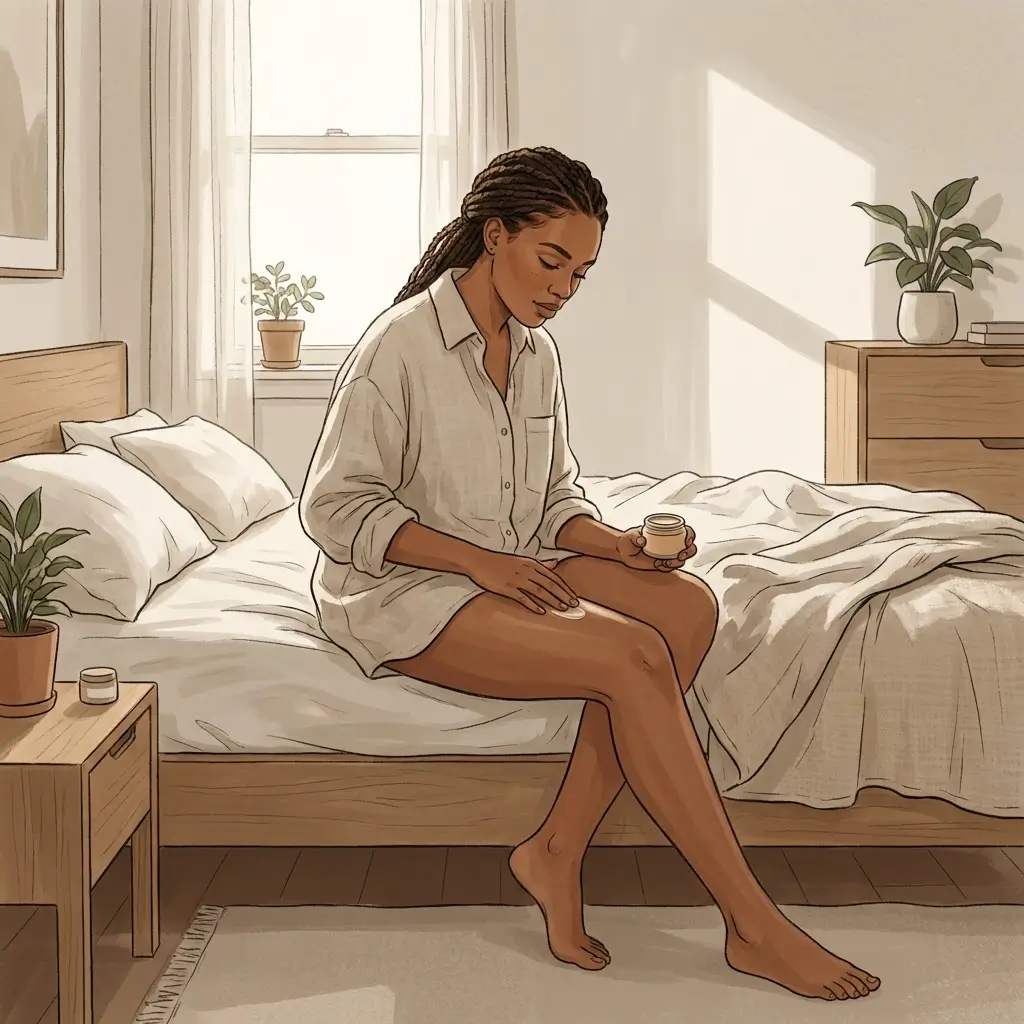
- Inner thighs. Skin-on-skin friction during walking. Extremely common, and one of the patterns people are least likely to talk about.
- Skin folds. Underarms, groin crease, under the breasts, and neck folds, where warmth and moisture compound the friction.
- Mask edges. Pigment along the jawline and cheeks from repeated mask wear, compounded by trapped heat.
- Straps and collars. Backpack straps, bag straps, shirt collars, and necklaces creating localised darkening at pressure points.
If you've been self-conscious about darkening in these areas, or felt like it's a problem nobody talks about, you're not alone. We hear about this pattern constantly. It just doesn't show up in mainstream skincare content because it's not facial hyperpigmentation, and most advice focuses above the jawline.
Why it persists
Most hyperpigmentation has a trigger event and then a resolution phase. A breakout happens, the inflammation resolves, and the PIH gradually fades. Friction-driven pigment doesn't follow that pattern because the trigger isn't a single event. It's ongoing.
As long as the friction source is present, your melanocytes in that area stay active. New pigment is being deposited daily, so the mark never gets a chance to clear. It can deepen over months and stabilise at a shade well darker than the surrounding skin.
That's what makes friction pigment feel permanent. It's not truly permanent, but the clock for fading only starts once the friction meaningfully reduces. And if the source is something you can't eliminate, like inner thigh contact during walking or a bra you wear daily, the pigment is being continuously reinforced.
That creates a specific kind of frustration. You can't stop wearing a bra. You can't stop walking. The triggers are woven into daily life, and "remove the trigger" isn't always realistic. If you've changed how you dress or what you're willing to wear because of darkening in these areas, that frustration is valid. The marks aren't caused by poor hygiene or anything you've done wrong. They're a predictable response in skin that's built to respond protectively.
What drives the severity
A few things determine how dark the marks get and how quickly they deepen:
Friction intensity. Harder seams, rougher fabrics, and tighter fits create more irritation per contact. Softer, seamless garments create less.
Heat and moisture. Areas that are warm and humid (under the breasts, inner thighs, skin folds) compound the friction. The heat adds its own pigment signal on top of the mechanical one.
Duration and frequency. Wearing the same garment style every day in the same position gives no recovery window. Even intermittent variation, alternating garment styles, occasionally going braless, or shifting where straps sit, slows the accumulation.
Your internal environment. Two people with similar skin can wear the same bra daily and see different darkening. Part of that comes down to what's happening internally. When background inflammation is already elevated from stress, disrupted sleep, or nutritional gaps, your melanocytes are primed to overreact to smaller triggers. The friction creates the disruption. The internal environment determines how aggressively your pigment responds. Reducing that background reactivity can mean the same friction produces less darkening than it used to.
Once friction is meaningfully reduced, the pigment does begin to fade. Recent accumulation tends to respond within a few months. Long-standing darkening takes longer because the melanin has settled deeper. The first sign is usually that the area stops getting darker, even before it visibly lightens. That stabilisation means the reduction is working.
The marks are real, visible, and valid. They're one of the most common forms of hyperpigmentation in brown and dark skin, and the fact that they don't get discussed much doesn't mean they're rare or unimportant. It means the conversation hasn't caught up with the reality of how melanin-rich skin actually lives in the world.


