


There's a specific kind of anxiety that comes with treating hyperpigmentation: you start a new product, your skin looks slightly worse for a few days, and you can't tell whether it's progress or damage.
Both are real possibilities. Some treatments do cause temporary darkening as they push pigmented cells to the surface faster. And some treatments genuinely irritate the skin enough to trigger new pigment production. The difference matters enormously, because one means you should keep going and the other means you should stop.
The problem is that they can look almost identical in the first two weeks.
What normal treatment response looks like
When an active ingredient like a retinoid or an AHA is working, it speeds up cell turnover. That means pigmented cells that were sitting deeper in the skin get pushed to the surface faster than they would on their own. During this phase, marks can temporarily look darker or more defined, because pigment that was diffuse is now concentrated in the outermost layers where it's more visible.
This is a sign the product is doing its job. It's uncomfortable to watch, but it's part of the process.
Normal treatment response usually looks like this:
- Marks appear slightly darker or sharper for one to three weeks after starting a new active
- The skin around the marks looks normal, no widespread redness or irritation
- There's mild flaking or dryness, but it isn't painful
- The darkening is limited to existing marks, not spreading to new areas
- After the initial phase, marks begin to look lighter than they did before you started
The key pattern is that the darkening is localised, temporary, and followed by visible improvement. If you're in this phase and everything around the marks looks healthy, you're probably on the right track.
What damage looks like
Damage from a routine usually doesn't announce itself clearly. It builds slowly, and because you're expecting some adjustment period, it's easy to rationalise the early signs.
But there are signals worth paying attention to:
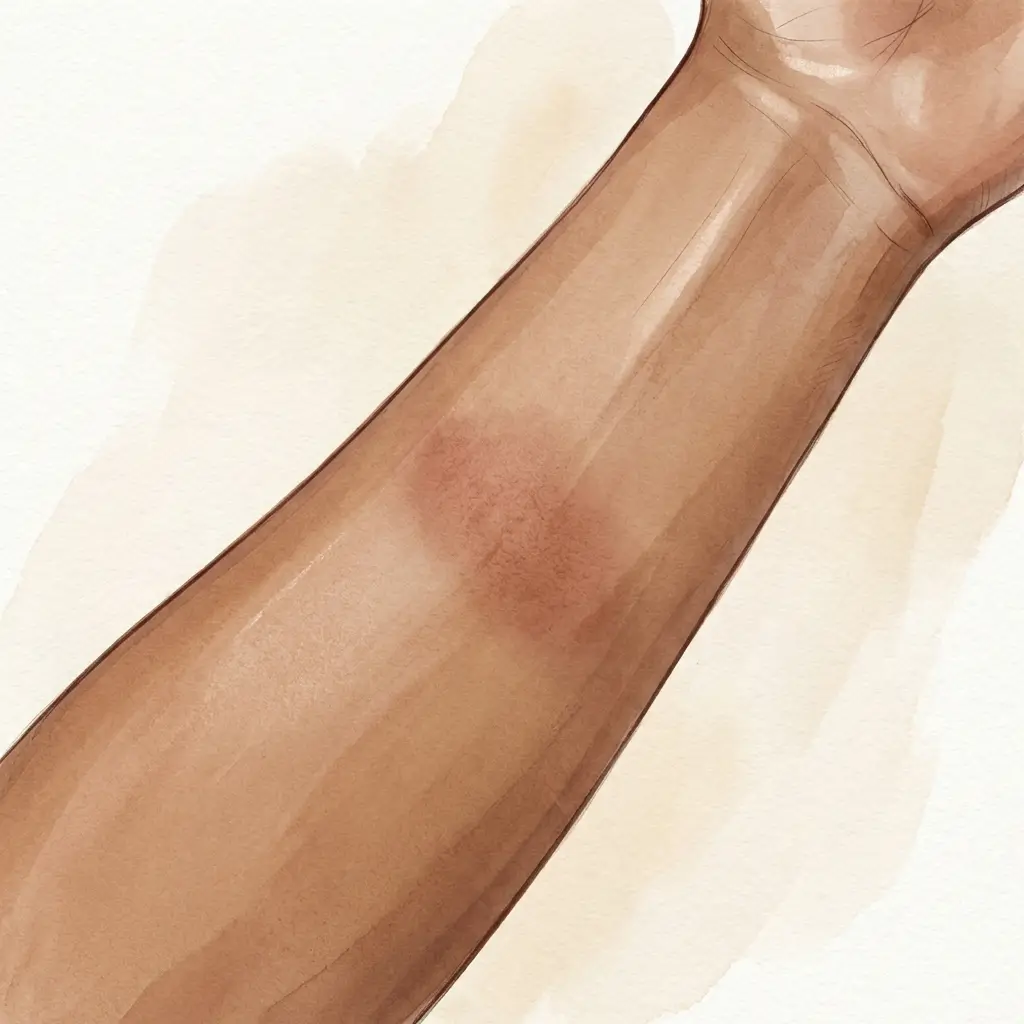
Widespread redness that doesn't resolve. Not the mild flush that fades after application. Redness that settles in across larger areas and is still there the next morning. This means the barrier is under stress, and a stressed barrier sends inflammation directly to your melanocytes.
Stinging or burning that gets worse, not better. A mild tingle on first application of a new acid is common. But if it's intensifying with each use, or if products that never stung before are now uncomfortable, your barrier is weakening.
New darkening in areas you weren't treating. This is the most important signal. If pigment is appearing in new locations, or if the edges of existing marks are spreading, your skin is producing pigment in response to irritation. That's new damage, not old pigment surfacing.
A shiny, tight, almost waxy texture. Over-exfoliated skin has a particular look. It reflects light differently, feels smooth but fragile, and reacts to everything. This texture means you've stripped too many layers and the barrier can't protect the skin underneath.
Redness that appears within minutes of application and fades within an hour is usually just sensitivity to the formula. Redness that lingers, spreads, or comes with stinging that escalates is telling you something different.
The irritation spiral
The most damaging pattern isn't a single bad product. It's the cycle that starts when irritation goes unrecognised and the response is to add more.
It usually goes like this: a mark isn't fading, so you add a stronger exfoliant. The skin gets slightly irritated, but you attribute it to the adjustment period. The irritation triggers more pigment, so the mark looks worse. You assume the product isn't strong enough and either increase frequency or add another active. The barrier deteriorates further, inflammation builds, and pigment production ramps up.
We hear this pattern constantly, and the frustrating part is that the person was trying to do everything right. The routine wasn't wrong at the start. It just crossed a line that's genuinely hard to see from the inside.
What makes this even harder to catch is that the line isn't fixed. Your skin's tolerance for active ingredients shifts depending on what's happening internally. When systemic inflammation is elevated, whether from stress, poor sleep, gut issues, or hormonal shifts, your threshold for irritation drops. A routine that worked fine for months can start causing damage not because you changed anything in the routine, but because something changed in you. That's why the spiral can seem to start from nowhere.
If your skin has been getting progressively more reactive over the past month and your marks have gotten darker rather than lighter, there's a good chance you've entered this spiral. The fix isn't another product. It's pulling back, and it's worth asking whether the shift started from the inside.
How to tell which one you're in
The clearest way to distinguish treatment response from damage is time and pattern.
Treatment response improves after two to four weeks. The darkening stabilises, then starts reversing. Damage gets worse over the same period, or stays the same while other symptoms pile up.
Treatment response is limited to existing marks. Damage creates new pigmentation or spreads existing marks.
Treatment response comes with mild, manageable side effects that decrease over time. Damage comes with side effects that increase or diversify, like stinging being joined by redness being joined by peeling being joined by new marks.
There's a third possibility worth considering: if the irritation started without any change in products, frequency, or application, the trigger may not be topical at all. Hormonal shifts, periods of high stress, and nutrient gaps can all lower your skin's tolerance from the inside, making a stable routine suddenly feel like too much.
If you're unsure, the safest move is to pause the active ingredient for five to seven days. Use only a gentle cleanser, a basic moisturiser, and sunscreen. If your skin immediately feels calmer and the redness starts resolving, that tells you the routine was pushing too hard. If nothing changes, the active was probably fine and the discomfort was just adaptation.
When to stop and when to push through
Keep going if: marks looked briefly darker but are now fading, side effects are mild and decreasing, new areas aren't being affected, and your skin's baseline texture still feels healthy.
Stop if: redness persists beyond a day, stinging is intensifying, new marks are appearing, the skin looks shiny or feels fragile, or you're using more than two active ingredients at the same time and can't tell which one is causing the issue.
Stopping doesn't mean abandoning the routine entirely. It means scaling back to the minimum while the barrier recovers, then reintroducing actives one at a time so you can identify exactly what your skin tolerates.
The hardest part
The hardest part of all of this isn't the biology. It's the emotional weight of watching marks darken and not knowing whether you're healing or hurting your skin.
That uncertainty is real, and it doesn't make you anxious or irrational. It makes you someone who's paying attention, which is exactly the right instinct. The goal isn't to stop paying attention. It's to give you better signals to interpret so the watching feels less like guessing and more like reading.
Your skin talks to you in patterns. The better you get at reading them, the less any single bad day will feel like a crisis. And if the patterns keep pointing to something your products can't reach, an inside-out approach might be the layer that's missing.


