


If you have been using a vitamin C serum faithfully and wondering why your pigment improved for a while and then stopped, this is the page that explains why. Not because your serum is bad. Because the oxidative stress driving your pigment is not only happening at the surface where your serum can reach. It is happening deeper, in the biochemical environment your melanocytes sit in, and that environment needs a different kind of support.
What oxidative stress actually does to your pigment
Reactive oxygen species (ROS) are generated constantly in your skin. UV exposure produces them. Pollution produces them. Stress produces them. Even normal cellular metabolism produces them. In small amounts, your body handles them fine. When the production outpaces your body's ability to neutralise them, you get oxidative stress, and oxidative stress is one of the primary signalling inputs that tells melanocytes to overproduce.
Here is how the cascade works. ROS activate several signalling pathways in your skin, including NF-κB, MAPK, and p53. These pathways upregulate tyrosinase expression and melanin production in your melanocytes. The melanocyte is not malfunctioning. It is responding to a signal. The signal says: this environment is under oxidative pressure, produce more pigment to protect the DNA in this area.
For pigment that has plateaued despite good topical care, this is often the missing piece. The topical approach is addressing the surface expression (suppressing the enzyme, clearing pigmented cells) while the oxidative environment beneath the epidermis keeps sending the production signal. You are cleaning up the output without quieting the input.
Why topical antioxidants hit a ceiling
Topical vitamin C neutralises ROS at the application site in the epidermis. That is genuinely useful. It reduces oxidative damage where it is applied and provides a layer of antioxidant protection beneath your sunscreen. Nobody is disputing that it works.
But topical vitamin C cannot influence systemic oxidative tone. It cannot reach the melanocyte microenvironment where the signalling pathways are being activated. It cannot cross the basement membrane and address the ROS being generated in the dermis and deeper tissue by UV, pollution, stress, and metabolic processes. It is doing real work at the surface layer and it has a hard biological boundary beneath that.
This is not a formulation failure. It is a delivery limitation. The epidermis is as far as topical delivery can reliably go. The signalling that is driving your melanocytes to overproduce originates below it.
The oral vs topical antioxidant question
This is the part that changes how you think about the problem.
When you take antioxidant compounds orally, they enter your bloodstream and reach tissues from the inside out. Vitamin C taken orally reaches the dermis, the melanocyte microenvironment, and the systemic circulation in ways that topical application cannot replicate. It is the same molecule doing different work because the delivery route gives it access to a different layer.
Oral vitamin C does not replace topical vitamin C. They are complementary. Topical handles the epidermis. Oral reaches the deeper environment. If your pigment has plateaued on a well-formulated topical vitamin C, the question is not whether you need a better serum. It is whether the oxidative stress driving your pigment is happening in a layer your serum was never designed to reach.
How systemic antioxidant support works
The body's antioxidant defence is not one molecule. It is a network, and the different compounds in that network work at different points.
Vitamin C is water-soluble. It neutralises ROS in the aqueous (water-based) environments of your cells and blood. When sourced from both ascorbic acid and plant extracts like amla fruit, you get the vitamin alongside the co-occurring polyphenols that support its absorption and recycling.
Vitamin E (d-alpha tocopheryl succinate) is fat-soluble. It sits in cell membranes and protects them from lipid peroxidation, the chain reaction where oxidative damage spreads through the fat-based structures of your cells. Vitamin C and vitamin E regenerate each other. C recycles oxidised E back to its active form. They are genuinely synergistic, not just "two antioxidants in one product."
Selenium (as selenomethionine) is a cofactor for glutathione peroxidase, one of your body's primary antioxidant enzyme systems. Glutathione is sometimes called the master antioxidant. Without adequate selenium, the enzyme that keeps glutathione cycling cannot function properly. This is foundational infrastructure, not a glamorous ingredient, but without it, the entire antioxidant network operates below capacity.
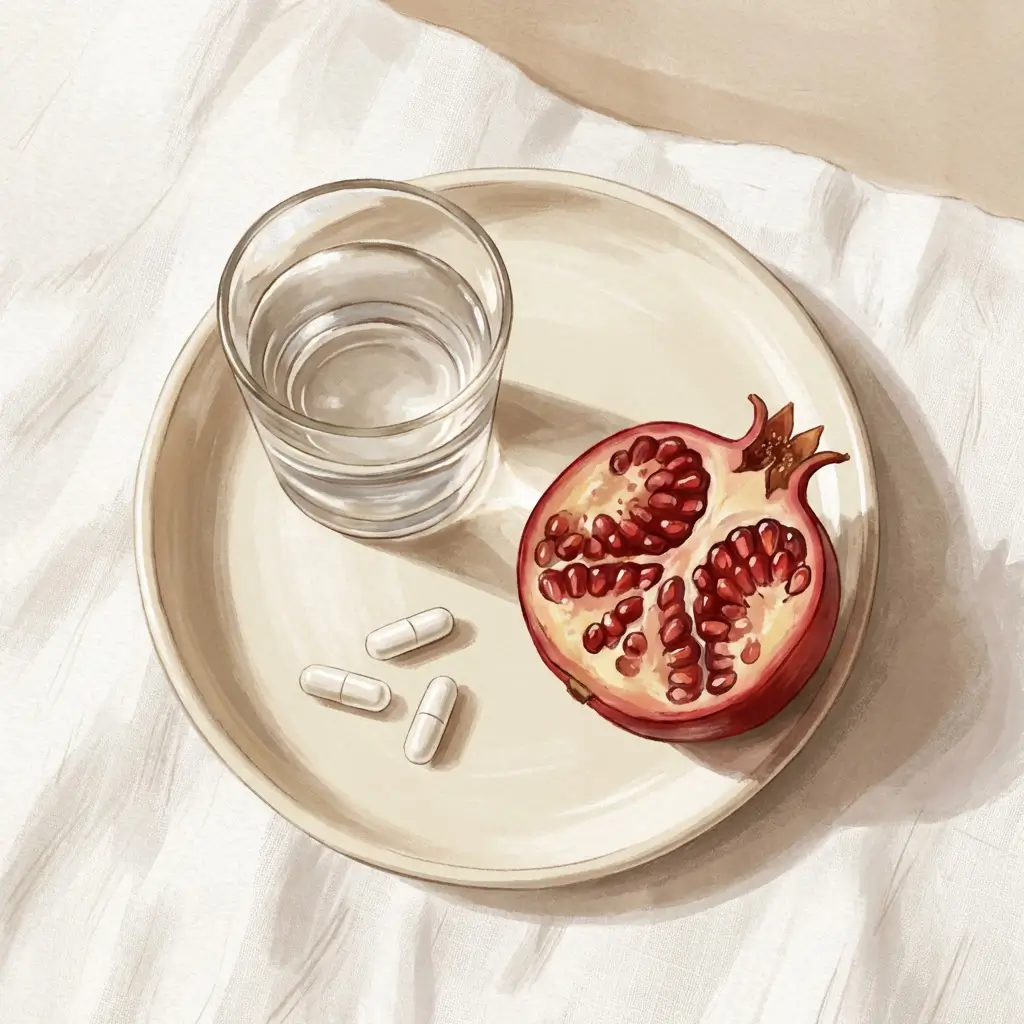
Polyphenol compounds work through slightly different mechanisms. EGCG from white tea has both direct antioxidant activity (scavenging ROS) and indirect effects on the signalling pathways that ROS activate. Pomegranate polyphenols (punicalagins) have high antioxidant capacity and evidence for protecting against UV-induced oxidative damage. Resveratrol manages oxidative stress through the Sirtuin and Nrf2 pathways, essentially strengthening your body's own antioxidant response rather than just donating electrons to neutralise free radicals.
CoQ10 operates at the mitochondrial level. Mitochondria are where your cells produce energy, and they are also a major source of ROS production. CoQ10 supports mitochondrial function and reduces oxidative leakage from the energy production process itself. Think of it as reducing ROS at the source rather than catching them after they have been released.
What this means for your pigment
When the oxidative environment your melanocytes sit in is chronically elevated (from cumulative UV exposure, ongoing stress, pollution, or just the metabolic load of daily life), the signalling pathways that drive melanin production stay activated regardless of what you are applying to the surface.
Systemic antioxidant support addresses that environment. Not by replacing your topicals, but by working at the layer they cannot reach. The topical approach manages the epidermal expression. The internal approach influences the oxidative signalling that is driving production from below.
When both layers are addressed, the gap between them narrows. The melanocyte is receiving less oxidative pressure from below while the surface is being managed from above. That is when plateaus break.
The oxidative stress driving your pigment is not just at the surface. Addressing it means reaching the environment your melanocytes actually sit in, which is deeper than your serum goes. That is not a limitation of your serum. It is why internal support exists.


