


Your pigment improved for a while and then stopped. The routine hasn't changed. The products are still good. But the progress that was visible in the first few weeks has stalled, and nothing you adjust seems to push past it.
This is one of the most common patterns in hyperpigmentation treatment, and oxidative stress is one of the most common reasons behind it. Not because your products aren't working. Because the oxidative environment deeper in the skin, where your melanocytes actually sit, hasn't changed. And that environment doesn't reset on its own. It accumulates.
Why oxidative stress accumulates
Your body produces free radicals constantly. Every cell that generates energy produces them as a byproduct. UV exposure produces them. Inflammation produces them. Pollution, stress, alcohol, poor sleep. They all add to the total.
Under normal conditions, your body handles this. You have antioxidant systems designed to neutralise free radicals as they're produced: glutathione, superoxide dismutase, catalase, plus the antioxidants you get from food. When production and neutralisation are roughly in balance, oxidative stress stays low and your melanocytes operate in a stable environment.
The problem is that this balance tips more easily than most people realise, and once it tips, it doesn't self-correct quickly.
Every day that free radical production exceeds your antioxidant capacity, the surplus causes damage. To cell membranes. To DNA. To the proteins and lipids in the tissue surrounding your melanocytes. That damage doesn't disappear when you sleep or eat well the next day. It accumulates. The damaged structures generate their own free radicals, which means yesterday's damage contributes to today's oxidative stress. The deficit compounds.
This is why oxidative stress behaves more like a debt than a balance. Small daily deficits that seem insignificant add up into a burden your body's repair systems can't clear as fast as it accumulates.
The loop with inflammation
Oxidative stress and inflammation don't just coexist. They drive each other in a self-reinforcing cycle that's central to why pigment gets stuck.
Free radicals activate NF-κB, one of the master switches for inflammatory gene expression. When NF-κB is activated, your body produces inflammatory cytokines. Those inflammatory cytokines generate more free radicals. The free radicals activate more NF-κB. The cycle runs.
For your melanocytes, this loop means they're receiving two signals simultaneously: oxidative signals telling them to produce pigment as a protective response, and inflammatory signals telling them to produce pigment as an immune response. Both signals point in the same direction. Both amplify the other.
This is why addressing inflammation without addressing oxidative stress (or vice versa) often produces incomplete results. They're not separate problems. They're two sides of the same loop, and breaking the loop requires reducing both.
Why chronic inflammation keeps hyperpigmentation active covers the inflammation side of this loop.
How this explains the plateau
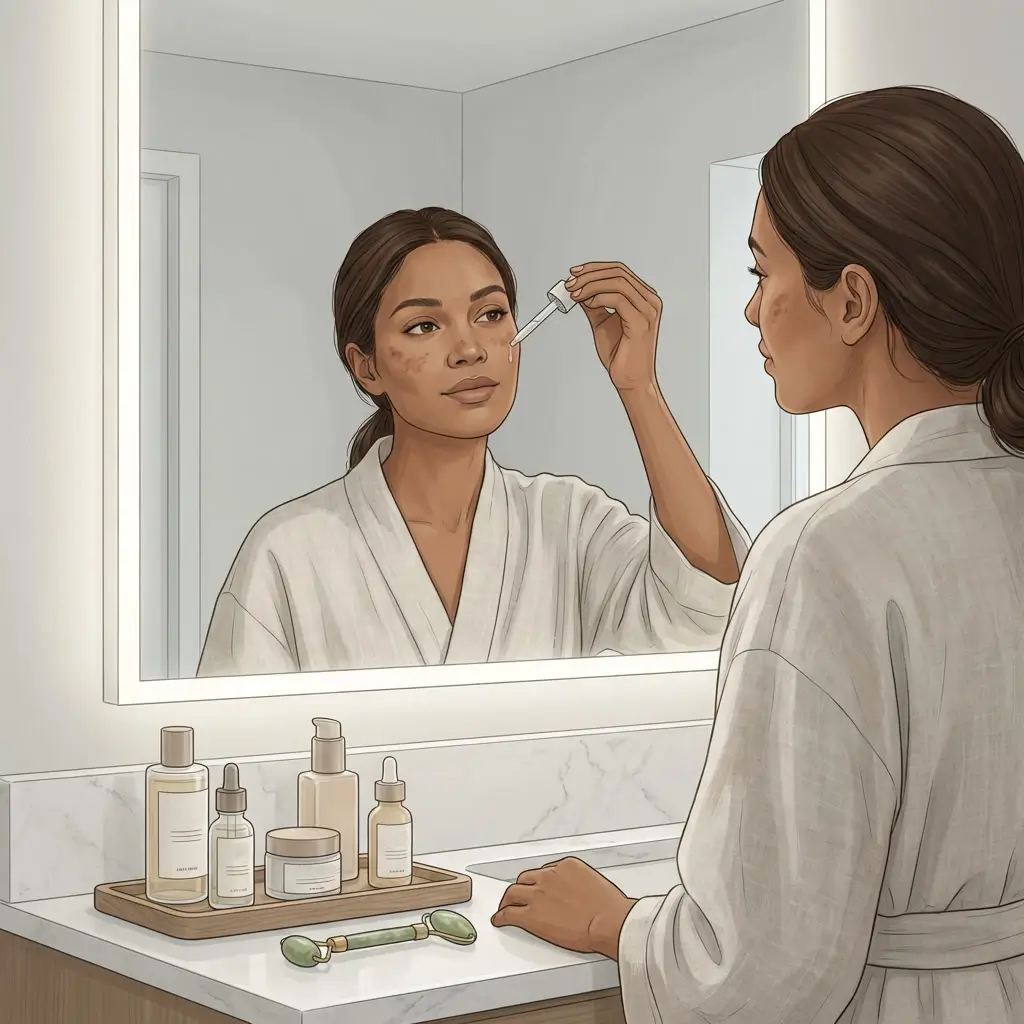
Many women see initial improvement with a good topical routine and then hit a wall. The pigment lightens to a point and stops. Or it improves and then seems to settle at a level that won't budge no matter how consistent the routine is.
Oxidative buildup is one of the most common explanations for this pattern.
In the early weeks of treatment, topical antioxidants (vitamin C, niacinamide) handle the oxidative stress they can reach in the upper layers of the skin. Tyrosinase inhibitors suppress some of the melanin production. Sunscreen reduces the UV-driven free radical load. Progress happens because the surface layer is being managed effectively. How free radicals trigger hyperpigmentation explains exactly how these signalling pathways work and why topical antioxidants have a biological ceiling.
But the deeper oxidative environment hasn't changed. The accumulated damage in the tissue surrounding your melanocytes is still generating free radicals. Systemic sources (stress, poor sleep, inflammation, metabolic stress) are still adding to the load. The signalling pathways that drive melanin production are still being activated from below.
The topical routine reached its ceiling. Not because the products stopped working, but because they were addressing the surface expression of a problem that runs deeper. The plateau is the point where what the surface can manage meets what the internal environment is still producing.
Why some people accumulate faster than others
The rate at which oxidative stress builds depends on two things: how much is being generated, and how effectively it's being neutralised. Both vary from person to person.
Higher generation. Women living in high-pollution environments, experiencing chronic stress, sleeping poorly, or dealing with ongoing inflammation from any source (gut, metabolic, hormonal) are producing free radicals at a higher rate. Multiple sources stack. A woman with chronic stress, poor sleep, and a daily commute through heavy traffic is generating oxidative stress from three directions simultaneously.
Lower neutralisation. Your antioxidant capacity depends on your diet, your nutrient status, and your body's internal antioxidant enzyme systems.Women with nutrient deficiencies (particularly zinc, selenium, vitamin C, and vitamin E), women on restrictive diets, and women with gut absorption issues may have antioxidant systems running below capacity. The free radicals aren't being neutralised as fast as they're being produced, and the gap between production and defence widens over time.
Melanin-rich skin adds another layer. Melanocytes in darker skin respond more strongly to the oxidative signals. The same oxidative environment that produces minimal visible effect in lighter skin can produce noticeable pigment changes in deeper skin tones. The threshold at which oxidative stress starts affecting pigment is lower, which means the accumulation doesn't need to be dramatic before it starts showing.
What this means for your approach
Oxidative stress isn't something you address once. It's an ongoing balance between what's being generated and what's being neutralised. For pigment, the goal is to shift that balance far enough that your melanocytes aren't sitting in a constantly elevated oxidative environment.
That means reducing what you can on the generation side. Daily habits that increase oxidative stress covers the specific sources worth addressing.
It also means supporting your body's capacity to neutralise what's already circulating. This is where dietary antioxidants matter, but it's also where the gap between what food provides and what the body needs becomes relevant. When oxidative stress has been accumulating for months or years, dietary intake alone is often not enough to close the deficit at the rate needed to shift the environment your melanocytes are sitting in.
Targeted antioxidant supplementation provides specific compounds at concentrations that help your body process the oxidative backlog: neutralising circulating free radicals, supporting your glutathione and enzyme systems, and breaking the oxidative-inflammatory loop at multiple points. It's the difference between maintaining a balance and actively clearing a deficit.
The topicals manage the surface. The lifestyle changes reduce the incoming load. The internal support helps your body resolve what's already built up. That's how the plateau breaks.


