


You've been dealing with eczema, or chronic hives, or food sensitivities that you've mostly learned to manage. And separately, you've been dealing with pigment that won't shift. You've probably been managing them in completely different conversations: the eczema with your dermatologist or GP, the pigment with your skincare routine. Nobody has suggested they might be related.
They often are. The chronic inflammation that drives your eczema, your hives, or your food reactions is the same inflammation that reaches your melanocytes and tells them to keep producing. One problem, running through two different expressions on your skin. Most people never connect the two because nobody joins the conversations together.
How histamine reaches your melanocytes
Histamine is one of the first molecules your immune system releases during an allergic response. It's what makes your eyes water during hay fever, what makes hives swell, and what drives the itch in eczema. Mast cells (immune cells that sit in your skin and other tissues) release histamine when they're triggered by an allergen.
Here's where it connects to pigment: histamine doesn't just cause itching and swelling. It triggers inflammation that produces the same signals that drive pigment production in any other inflammatory context. When that reaction is short-lived (a single allergic episode that passes), the pigment impact is limited. Maybe a bit of darkening at the site, maybe a mark that fades.
When the inflammation is chronic (ongoing eczema, recurring hives, food sensitivities keeping your immune system in a low-grade reactive state), it doesn't resolve. Your melanocytes sit in an environment where the production signals never fully switch off. This is the same reason any chronic inflammation drives pigment. What's specific to allergies and histamine is that the inflammation is being driven by immune reactions rather than stress or metabolic inputs, and the treatment approach is different
Eczema and the pigment it leaves behind
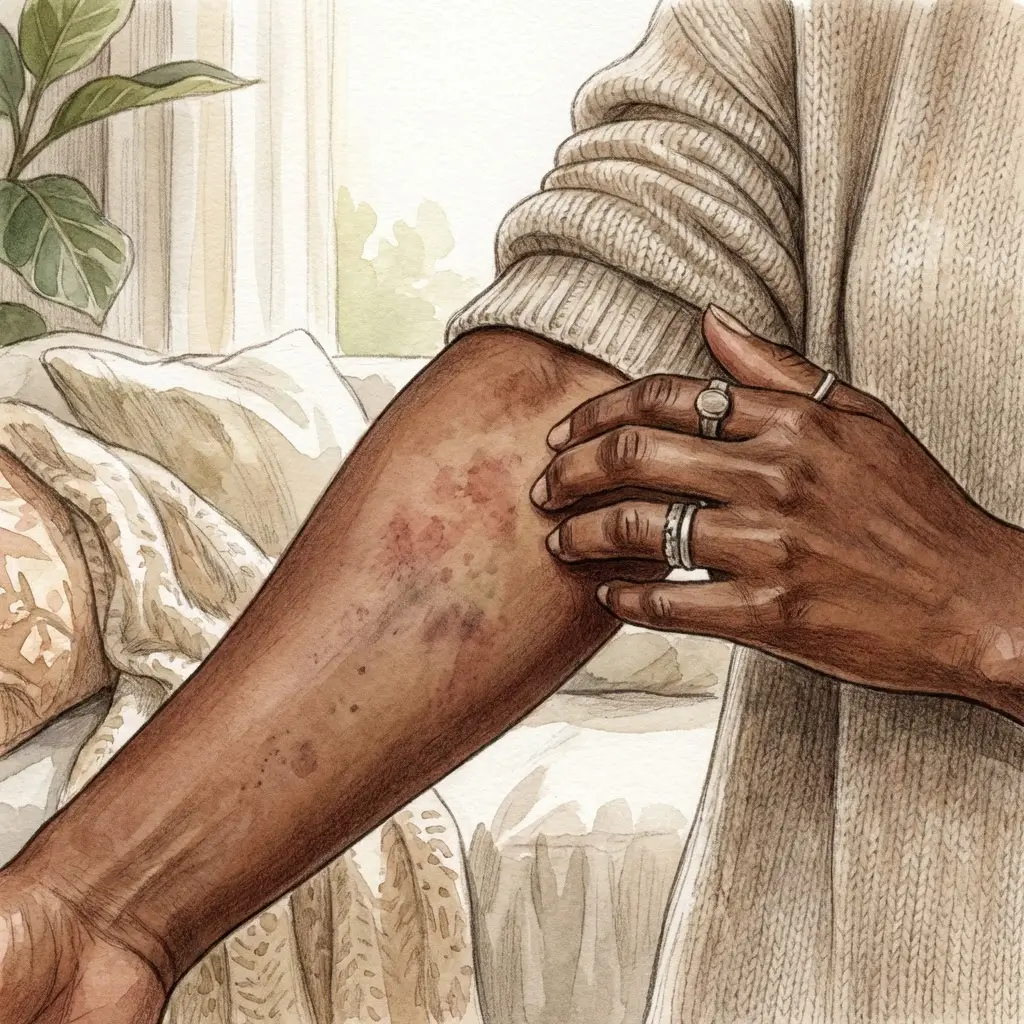
Eczema is probably the most common place where allergic inflammation and hyperpigmentation collide.
Every eczema flare is a burst of inflammation. The skin becomes inflamed, the barrier breaks down, and melanocytes in the affected area respond by producing excess pigment. When the flare resolves, the pigment stays behind as post-inflammatory hyperpigmentation.
For many people with eczema, especially those with deeper skin tones, the dark marks become a bigger concern than the eczema itself. The redness and irritation clear up. The marks persist for months. If you've reached the point where you dread the marks more than the flare that causes them, you're not alone in that.
But here's what makes eczema-driven marks different from marks left by a single breakout: even between visible flares, the immune system in someone with active eczema is running at a higher level of reactivity. Mast cells are more primed. Histamine levels may be elevated. The inflammation reaching your melanocytes doesn't fully resolve between episodes.
The allergic inflammation is doing double duty: causing the flare and maintaining the pigment the flare leaves behind. This is why eczema-driven marks fade so slowly compared to marks from a one-off event. The mark was created by a flare. The ongoing inflammation is maintaining it. Until the underlying immune activity is better managed, the pigment exists in an environment that actively resists fading.
Chronic hives, food sensitivities, and the low-grade pattern
Not all histamine-driven inflammation produces visible skin symptoms at the site of the pigmentation. This is where the connection gets harder to see.
Chronic hives keep the immune system in a state of persistent reactivity. Even when hives aren't visibly present, the inflammation associated with them may be running at a lower level in the background. That reaches melanocytes everywhere, not just at the sites where hives appear.
Food sensitivities create a different version of the same pattern. Unlike true food allergies (which produce an immediate, dramatic reaction), sensitivities produce a delayed, lower-grade immune response. You eat something your body reacts to, your gut immune system activates, and the resulting inflammation circulates. When the trigger food is a regular part of your diet, the immune response never fully resolves, and that's where the gut-skin connection becomes directly relevant to your pigment.
The pattern to watch for: pigment that seems to track with periods of immune flare-up rather than specific skin-level events. Pigment that worsens when your allergies are active or when you've been eating trigger foods regularly, and that improves slightly during stretches when those triggers are absent.
The gut connection
There's a gut component worth understanding, because it connects the histamine picture to the broader internal environment.
When the gut lining lets more through than it should (often associated with food sensitivities, chronic stress, and an imbalanced microbiome), your immune system treats those things as threats and responds with inflammation. If you're already prone to histamine-driven reactions, this gut-driven inflammation adds to the overall pressure.
Some people also have a reduced ability to break down histamine itself. The enzyme responsible for this in the gut (diamine oxidase, or DAO) can be impaired by gut inflammation, certain medications, and alcohol. When histamine isn't being broken down efficiently and the gut is letting more immune triggers through, the overall inflammatory pressure rises even without an obvious allergic trigger.
This is the pattern that confuses people. No specific allergy has been diagnosed. No single food consistently causes a reaction. But the overall level of inflammation in the body is elevated, and the melanocytes are responding to it.
What you can influence and what needs medical support
If you recognise this pattern, the approach involves both reducing the immune and inflammatory inputs and managing the conditions driving them.
Managing the underlying condition comes first. If eczema, chronic hives, or a specific allergy is diagnosed, working with your doctor on the medical management of that condition reduces the inflammation reaching your melanocytes. That's the upstream intervention no supplement or skincare product can replace.
Identifying and reducing trigger foods helps if food sensitivity is part of the picture. An elimination protocol under professional guidance is more reliable than guesswork. Removing random foods without tracking often misses the actual triggers.
Supporting gut health helps reduce the leakiness and immune overreaction that amplifies the histamine and inflammation cycle. The gut-skin connection is especially relevant here because the gut is where much of the histamine load originates.
Supporting your skin from the inside matters here because the inflammation that's already built up at the skin level needs to be actively resolved. Anti-inflammatory and antioxidant support gives your body the tools to clear that backlog while the upstream allergic picture is being managed. Medical management addresses the immune drivers. Internal nutritional support helps your skin recover from the damage those drivers have already done.
The two problems you've been managing separately may need to be managed together, and once they are, both tend to respond better than either one did on its own.


