


You hear about the nausea, the swelling, the fatigue. Nobody sits you down and says, "By the way, your skin is about to change colour in places you were not expecting, and it might or might not go back to normal afterward."
But for a huge number of women, that is exactly what happens. Dark patches appear across the cheeks and forehead. The line down the centre of the belly deepens. Freckles and moles darken. Areas of friction that were never noticeable before suddenly become visible. And if you had any existing pigmentation before pregnancy, there is a good chance it just got worse.
This is not random. It is one of the most predictable and well-understood pigmentation triggers in dermatology. Pregnancy creates the most potent hormonal environment for melanocyte activation that most women will ever experience. And once you understand the mechanism, a lot of things that feel confusing or alarming start to make sense.
What pregnancy does to your melanocytes
The short version: pregnancy floods your body with estrogen and progesterone at levels far beyond anything your skin has dealt with before. And both of those hormones talk directly to melanocytes.
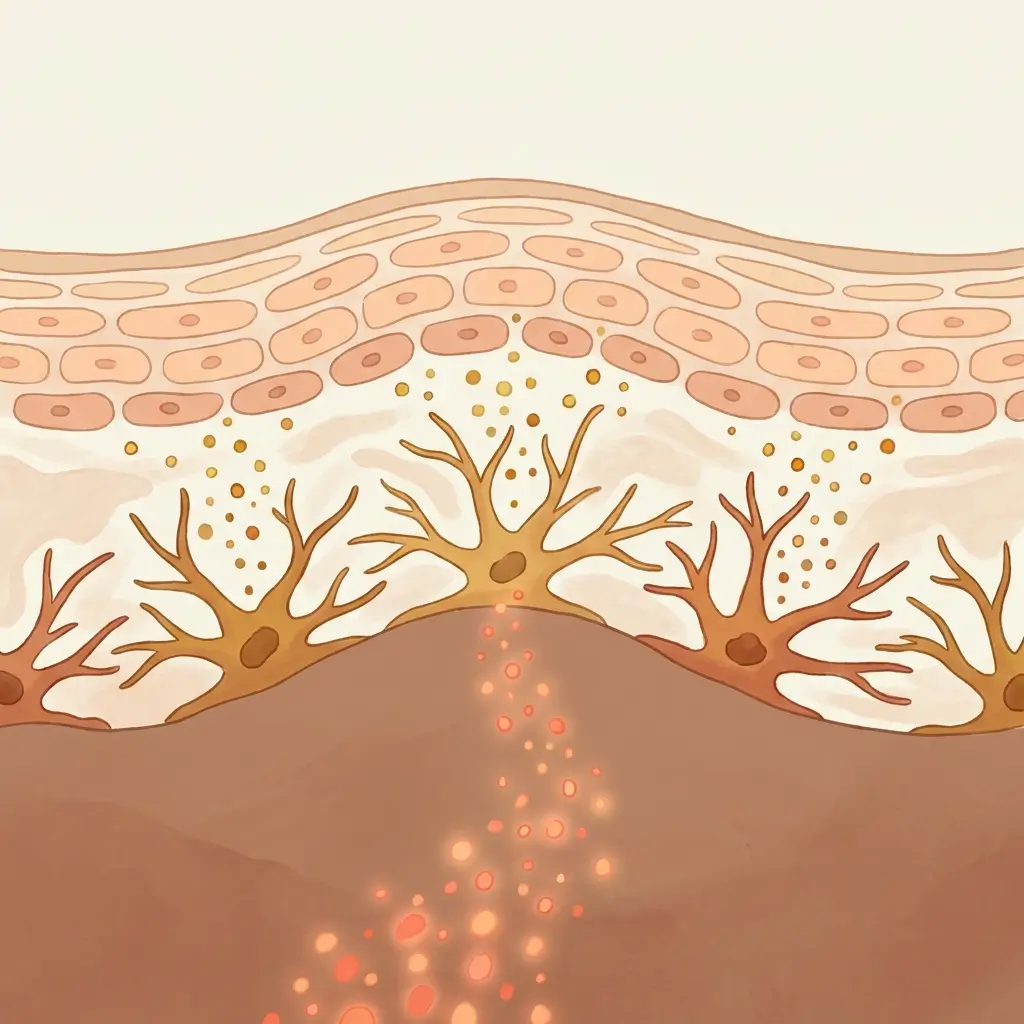
Melanocytes have estrogen receptors and progesterone receptors on their surface. When those receptors are activated, the melanocyte responds by upregulating tyrosinase, the enzyme that drives melanin production. More hormone stimulation means more enzyme activity, which means more pigment.
This is not a subtle effect. Estrogen levels during pregnancy can rise to hundreds of times their normal baseline by the third trimester. Progesterone follows a similar curve. The melanocytes are not just being nudged. They are being driven hard, for months, by the most powerful signal they have ever received.
On top of the direct hormonal stimulation, pregnancy also increases melanocyte-stimulating hormone (MSH), which adds another layer of activation. And the placenta itself produces hormones that further amplify the signalling. Your melanocytes are essentially getting the same message from multiple directions at once: produce more pigment.
That is why pregnancy-related pigmentation is so widespread. It is not localised irritation or a single inflammatory event. It is a systemic, body-wide hormonal instruction to every melanocyte in your body to work harder.
Where it shows up
Pregnancy-related pigmentation does not hit everyone the same way, but there are patterns.
- Melasma is the most well-known presentation. Symmetrical brown or grey-brown patches, typically across the cheeks, forehead, upper lip, and sometimes the jawline. It is so closely associated with pregnancy that it is still sometimes called "the mask of pregnancy." It affects an estimated 50 to 70 percent of pregnant women to some degree.
- Linea nigra is the dark line that appears vertically down the centre of the belly. It follows a line of connective tissue (the linea alba) that was always there but becomes visible when melanocytes along it are activated by hormonal surges. Nearly every pregnant woman develops some version of this.
- Darkening of existing pigmentation. Freckles, moles, birthmarks, areolae, and genital skin often darken during pregnancy. This is the generalised melanocyte activation at work. If there was already pigment there, the cells producing it are now working harder.
- Darkening of friction areas. The inner thighs, underarms, neck folds, and anywhere clothing rubs can darken more visibly during pregnancy. The hormonal environment lowers the threshold at which mechanical irritation triggers a pigment response, so friction that never caused visible darkening before may start to.
Not all of this is melasma. Melasma is the specific pattern driven by hormonal sensitivity in particular facial melanocytes. The rest is generalised hyperpigmentation from the body-wide hormonal surge. They look different, they behave differently after pregnancy, and they have different implications for what happens next.

Why melanin-rich skin is affected more visibly
This pattern will be familiar if you have read the other articles in hyperpigmentation causes, melanocytes in melanin-rich skin operate at a higher baseline, respond more strongly to stimulation, and produce more pigment per activation.
During pregnancy, that baseline is being hit with the most powerful hormonal stimulus it has ever encountered. The melanocytes that were already more efficient and more responsive get pushed further, faster, and more visibly than they would in lighter skin.
This is why melasma during pregnancy tends to be more pronounced and more persistent in women with deeper skin tones. It is not that pregnancy affects melanin-rich skin differently in kind. It affects it differently in degree. The signal is the same. The response is amplified.
It also means that the generalised darkening (friction areas, linea nigra, areolae) tends to be more noticeable and can take longer to resolve postpartum. The melanocytes were driven harder, produced more pigment, and in some cases may have undergone more lasting changes as a result.
Why it sometimes resolves after pregnancy and sometimes does not
This is the question that matters most to women living with it, and the answer is genuinely complicated.
What tends to resolve
The generalised hyperpigmentation, linea nigra, areolar darkening, friction-area darkening, darkened freckles and moles, usually fades after delivery as estrogen and progesterone levels drop back to pre-pregnancy baseline. The hormonal instruction to overproduce pigment stops, and the melanocytes gradually return to their normal activity level. Cell turnover does the rest, shedding the excess pigmented cells over the following weeks and months.
For many women, this process takes 6 to 12 months postpartum. It is not instant, and the timeline is longer if you are breastfeeding, because breastfeeding maintains elevated hormone levels that can sustain melanocyte activation to a lesser degree.
What sometimes does not resolve
Melasma is the wildcard.
For some women, pregnancy-triggered melasma fades along with everything else once hormones normalise. For others, it persists for years or becomes permanent. The difference comes down to what happened to the melanocytes during the months of sustained hormonal stimulation.
When melanocytes are activated intensely and for a prolonged period, some of them undergo changes that persist even after the stimulus is removed. They develop a kind of cellular memory, remaining in a sensitised, more easily reactivated state long after the pregnancy hormones have cleared. The melanocytes are not permanently damaged, but they are permanently primed. They now respond to triggers (UV, heat, mild hormonal fluctuations from the menstrual cycle, stress) that would not have activated them before pregnancy.
This is the shift from "pregnancy-triggered melasma" to "chronic melasma." The pregnancy was the initiating event, but the condition takes on a life of its own.
There is no reliable way to predict in advance whether your pregnancy melasma will resolve or persist. The factors that seem to matter most are:
- Skin tone. Women with melanin-rich skin are more likely to develop persistent melasma. The melanocytes were driven harder and are more susceptible to lasting sensitisation.
- Severity during pregnancy. More intense melasma during pregnancy correlates with higher likelihood of persistence.
- Subsequent pregnancies. Each pregnancy that triggers melasma tends to deepen and entrench it. Women who had melasma in a first pregnancy often find it returns faster and more severely in subsequent ones.
- UV exposure during and after pregnancy. Unprotected sun exposure during the period when melanocytes are maximally sensitised appears to contribute to lasting changes. UV locks in what might otherwise have been temporary.

What you can do during pregnancy
Treatment options during pregnancy are limited, and they should be. Most topical actives used for pigmentation (retinoids, hydroquinone, high-strength chemical exfoliants) are either contraindicated or not recommended during pregnancy. This is not the time to attack the pigment with an aggressive routine.
But there are things that genuinely help.
Sun protection becomes non-negotiable
If there is a single intervention that matters most during pregnancy, it is rigorous sun protection. Your melanocytes are already being driven by the most powerful hormonal stimulus they have ever received. Adding UV stimulation on top of that is what pushes the response from "temporary pregnancy pigmentation" toward "persistent melasma that outlasts the pregnancy."
- Broad-spectrum SPF 30 or higher, every day, reapplied.
- Tinted sunscreens with iron oxide to block visible light, which can independently stimulate melanocytes.
- Hats, shade, and awareness of incidental exposure.
This will not prevent pregnancy pigmentation entirely. The hormonal driver is too strong. But it can meaningfully reduce the severity and improve the odds that it resolves postpartum.
Keep the routine gentle
The instinct to fight the pigmentation with actives is understandable but counterproductive during pregnancy, both for safety reasons and because irritation on top of hormonal activation will make things worse.
A gentle, barrier-supporting routine (mild cleanser, moisturiser, sunscreen) is doing more than it looks like. It is keeping the skin calm, protecting the barrier, and not adding an inflammatory trigger to a system that is already primed to overreact. Azelaic acid, at strengths considered safe by your provider is one of the few actives considered safe during pregnancy and can provide mild tyrosinase inhibition without significant irritation risk. Check with your provider before introducing it.
The postpartum window
The months after delivery are when the trajectory of your pregnancy pigmentation becomes clearer. Generalised darkening begins to fade as hormones normalise. Melasma may start to lighten on its own, or it may hold steady.
This is a critical window, not for aggressive treatment, but for giving your skin the conditions it needs to resolve what it can on its own.
- Continue sun protection. The melanocytes are still sensitised. UV exposure in the postpartum months can reactivate pigment that was starting to fade.
- Keep the routine simple while the skin recalibrates. Your hormones are still shifting, especially if you are breastfeeding. A calm, supportive routine gives the melanocytes the best chance to settle.
- Be patient before escalating. If your melasma has not resolved by 6 months postpartum (or by 6 months after stopping breastfeeding), it is reasonable to start exploring active treatment. Jumping to treatment too early means potentially treating pigment that would have resolved on its own.
For treatment approaches if the melasma persists, see How to Treat Melasma.
What to take from this
Pregnancy-related pigmentation is not a flaw or a failing. It is a completely predictable biological response to the most powerful hormonal shift your body will go through. Nearly every pregnant woman experiences it to some degree.
The things you can control during pregnancy are limited, but they matter. Consistent sun protection can reduce severity and improve the chances of postpartum resolution. A gentle routine avoids adding irritation to an already activated system. And understanding the mechanism helps you make informed decisions rather than panicking and reaching for products that are either unsafe or counterproductive.
The most important perspective shift is this: pregnancy pigmentation is not a problem that needs to be fixed during pregnancy. It is a change that needs to be managed gently during, supported intelligently after, and treated only if it persists. That patience is not passive. It is the most skin-literate response there is.
Your skin is responding to something extraordinary. Treating it gently during that time is not doing nothing. It is doing the right thing.


