


Nobody builds a skincare routine hoping it will make their pigmentation worse. But it happens constantly. And the reason it keeps happening is that the early signs of irritation-driven damage look almost identical to the early signs of a product working.
A little redness. Some tightness. Maybe mild flaking. You were told this was normal. "Your skin is purging." "Give it time to adjust." "Push through the first two weeks." So you pushed through. And somewhere along the way, the spots you were treating got darker, or new ones appeared, and you could not figure out why, because you were doing everything right.
What follows explains what actually happens when skincare products damage your skin into producing more pigment. Not because the products themselves are bad, but because the way they are used creates exactly the kind of low-grade inflammation that melanocytes respond to.
The mechanism is the same one behind every other trigger
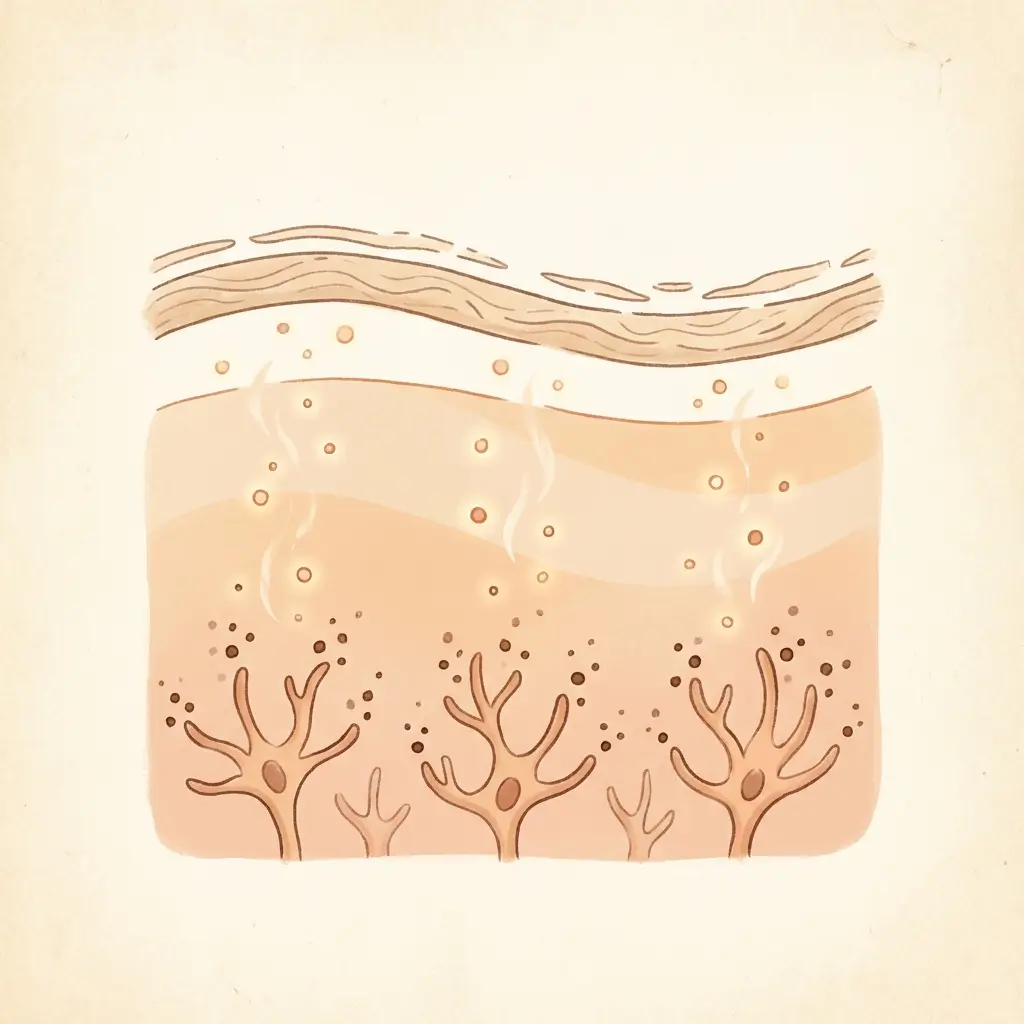
If you have read the other articles in hyperpigmentation causes, you already know the core pathway. Damaged or stressed skin cells release inflammatory signals. Those signals reach melanocytes. Melanocytes respond by producing more pigment.
It does not matter whether the damage comes from a laser, a razor, UV exposure, or a 20% glycolic acid you used every night for three weeks. The melanocyte does not know the difference. It receives inflammatory signals, and it does what it has always done: makes melanin to protect the area.
The difference with skincare-induced irritation is that it tends to be low-grade, widespread, and chronic. It is not a single dramatic event. It is a slow, cumulative accumulation of micro-damage that often goes unrecognised because it never gets bad enough to feel like an emergency. It just simmers.
And that simmer is enough.
How it actually plays out in your routine
The scenario is almost always some version of the same pattern. You have pigmentation you want to fix. You research actives. You build a routine around ingredients known to target hyperpigmentation. And then you use them in a way that, despite your best intentions, creates a low-level injury cycle that feeds the very problem you are trying to solve.
Here are the most common ways it happens:
Too many actives at once
A retinoid for turnover. A vitamin C for brightening. An AHA for exfoliation. A niacinamide for melanin transfer. Each one has a legitimate role in pigmentation treatment. But layered together, especially when introduced at the same time, they create a cumulative irritation load that the skin cannot absorb without becoming inflamed.
Your skin does not process each product independently. It experiences the total chemical stress of everything applied to it. Four gentle products at once can add up to one aggressive one.
Over-exfoliation
This is one of the most common and least recognised causes of routine-induced pigmentation. Chemical exfoliants (AHAs, BHAs, PHAs) work by dissolving the bonds between dead skin cells, accelerating their shedding. That is useful in moderation. But used too frequently, at too high a concentration, or layered with other actives that also disrupt the surface, they strip the outer barrier faster than the skin can rebuild it.
The result is skin that is perpetually raw beneath the surface. Not visibly peeling, necessarily. Just thinned, sensitised, and producing a constant stream of low-grade inflammatory signals. That is exactly the environment melanocytes respond to.
Retinoid irritation mistaken for progress
Retinoids are one of the most effective tools for hyperpigmentation. They are also one of the most common causes of irritation-driven pigment when used incorrectly.
The "retinisation" phase (redness, dryness, flaking when you first start a retinoid) is real, and for many people it does settle. But there is a line between temporary adjustment and ongoing damage, and it is not always obvious which side you are on. If the redness, tightness, or sensitivity persists beyond a few weeks, or if your skin never quite feels comfortable, it is not adjusting. It is being injured, repeatedly, at a level just low enough that you keep going.
For melanin-rich or reactive skin, the tolerance for this kind of sustained irritation is lower. The melanocytes will respond before the visible signs get dramatic enough to alarm you.
Barrier damage from actives or cleansing
Your skin's barrier is the outermost layer that holds moisture in and keeps irritants out. When it is intact, the skin beneath it is protected from the kind of environmental and chemical stress that triggers inflammation. When it is compromised, everything gets in. Products that were fine on healthy skin suddenly sting. Environmental exposure that would not normally matter starts affecting melanocyte activity.
Barrier damage accumulates from harsh cleansers (high pH, stripping surfactants), over-use of chemical exfoliants, alcohol-heavy products, and routines that are simply doing too much. The irony is that many of these products are marketed specifically for pigmentation or "dull skin," meaning the people most likely to use them aggressively are the people most vulnerable to the consequences.
Why the damage is hard to recognise
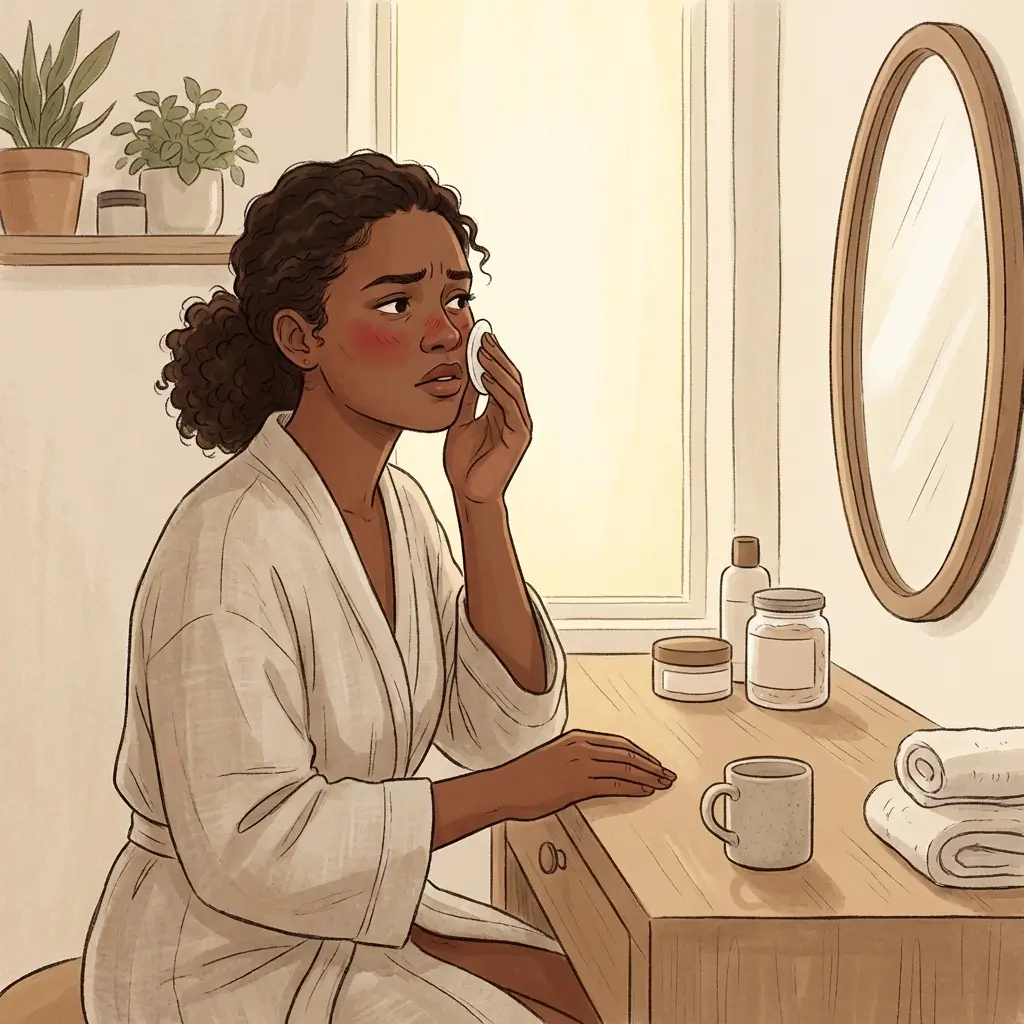
This is the cruelest part of the cycle. Irritation-induced pigmentation does not usually announce itself with obvious symptoms. It builds in a grey zone where the signals are ambiguous.
Redness gets read as "working." When a new active makes your skin flush slightly, you assume it is doing something. And it might be. But if that redness does not settle, it is inflammation, and inflammation talks to melanocytes.
Flaking gets read as "exfoliation." Peeling skin after starting a retinoid or acid feels like progress. Dead skin coming off, fresh skin underneath. But excessive or prolonged flaking means the barrier is being stripped faster than it regenerates. The "fresh" skin underneath is not renewed. It is exposed and vulnerable.
Tightness gets read as "clean." That squeaky, pulled feeling after cleansing is not a sign of thoroughness. It is the absence of the lipid layer that protects your skin. Without it, moisture escapes and irritants enter more freely.
New dark marks get blamed on something else. When pigmentation appears or worsens during an active-heavy routine, the assumption is that it is from the underlying condition (acne, sun damage, hormones) rather than from the treatment itself. The routine does not come under suspicion because it is the thing you are doing about the problem. The idea that it could be the problem does not occur to most people.
This is how women end up in cycles that last months or years. The treatment causes irritation. The irritation triggers pigment. The new pigment motivates more aggressive treatment. The more aggressive treatment causes more irritation. At no point does the routine itself get questioned, because every individual product in it seems reasonable.
Why melanin-rich and reactive skin pays a higher price
If your melanocytes are already operating at a higher baseline (which they are in melanin-rich skin), the threshold at which routine irritation triggers a visible pigment response is lower.
The same retinoid strength, the same AHA percentage, the same number of actives layered in the same routine. On lighter or less reactive skin, the irritation might produce mild redness that fades in a day and no pigment changes. On melanin-rich skin, the same irritation can produce a pigment surge that takes months to clear.
This is compounded by the fact that much of the skincare advice available online (including from dermatologists and aestheticians) is calibrated for skin that is less reactive than yours. "Start with 0.5% retinol" might be sensible for one person and too aggressive for another. "Use your AHA three times a week" might be fine for your friend and inflammatory for you. The standard starting points are not universal, and they are especially unreliable for women whose skin responds to irritation by producing pigment.
The safest assumption, if you have melanin-rich or reactive skin, is that every new active is guilty until proven innocent. Introduce one thing at a time, at the lowest effective strength, and watch what your skin does over weeks, not days.

The role of internal health in breaking the cycle
When your skin's barrier is compromised and your melanocytes are being chronically stimulated by routine irritation, the problem is not just what is happening on the surface. The skin's internal resources are under strain too.
A healthy barrier requires adequate lipid production, proper hydration, and efficient cell turnover. All of these depend on nutritional and systemic factors that go beyond what you apply topically. Oxidative stress from chronic irritation depletes the skin's antioxidant reserves. Inflammation, even the low-grade kind from over-exfoliation, draws on internal resources that the body has to replenish from somewhere.
This is part of why some women can use aggressive routines and seem fine while others react to relatively mild products. The difference is not just skin type. It is the internal environment supporting the skin. When that environment is depleted, the threshold for irritation drops and the pigment response is stronger.
Our Hyperpigmentation Cleanse Capsules are designed to support the skin from this direction. Antioxidant compounds to help counteract the oxidative stress from ongoing irritation. Anti-inflammatory support to help quiet the signalling that keeps melanocytes reactive. And nutrients that support barrier repair and healthy cell turnover from the inside, so the skin can rebuild more efficiently once the external damage stops.
Stripping back your routine is the first move. Supporting the skin's recovery internally is what helps it actually heal.
What this means for your decisions
This is about the mechanism, understanding why your routine might be triggering pigment so that you can recognise the pattern. Recognising it is the hardest part, because it means being willing to question the thing you are doing to help.
For practical guidance on rebuilding a routine that treats pigmentation without causing it, hyperpigmentation routines covers that in detail. For maintaining the barrier health that prevents this cycle from starting, see the barrier health guide.
The most important thing to take away is this: your skincare routine is not neutral. Every product you apply is either supporting your skin or stressing it, and the line between the two is thinner than most product marketing acknowledges. If your pigmentation is not improving despite doing "all the right things," the right things might be part of the problem.
The hardest treatment decision is sometimes the simplest one: do less.


