


You've been doing everything right. Sunscreen every day. A gentle routine. Maybe a retinoid or a tyrosinase inhibitor you introduced slowly. You gave it time. And now, a few weeks in, the pigmentation looks worse, darker, more defined, more visible than when you started.
This is the moment most people panic. They assume the treatment is failing, or that it's making things worse, and they either stop everything or escalate to something more aggressive. Both reactions are understandable. Both are usually wrong.
What you're often seeing is not new pigment being created. It's existing pigment being moved to the surface on its way out.
What is actually happening
Your skin renews itself from the bottom up. New cells are produced at the base of the epidermis, and over the course of roughly four to six weeks, they migrate upward, flatten, die, and eventually shed from the surface. This is the normal turnover cycle.
Pigment follows the same path. When melanocytes produce melanin, they transfer it into the surrounding keratinocytes. Those pigmented cells then travel upward with the rest of the turnover process. The pigment you see on the surface today was deposited into cells weeks ago.
When you start a treatment that accelerates turnover (retinoids are the most common example, but exfoliating acids and certain other actives do this too), you're speeding up that conveyor belt. Cells that were sitting deeper in the epidermis, carrying their pigment load, are being pushed to the surface faster than they would be naturally.
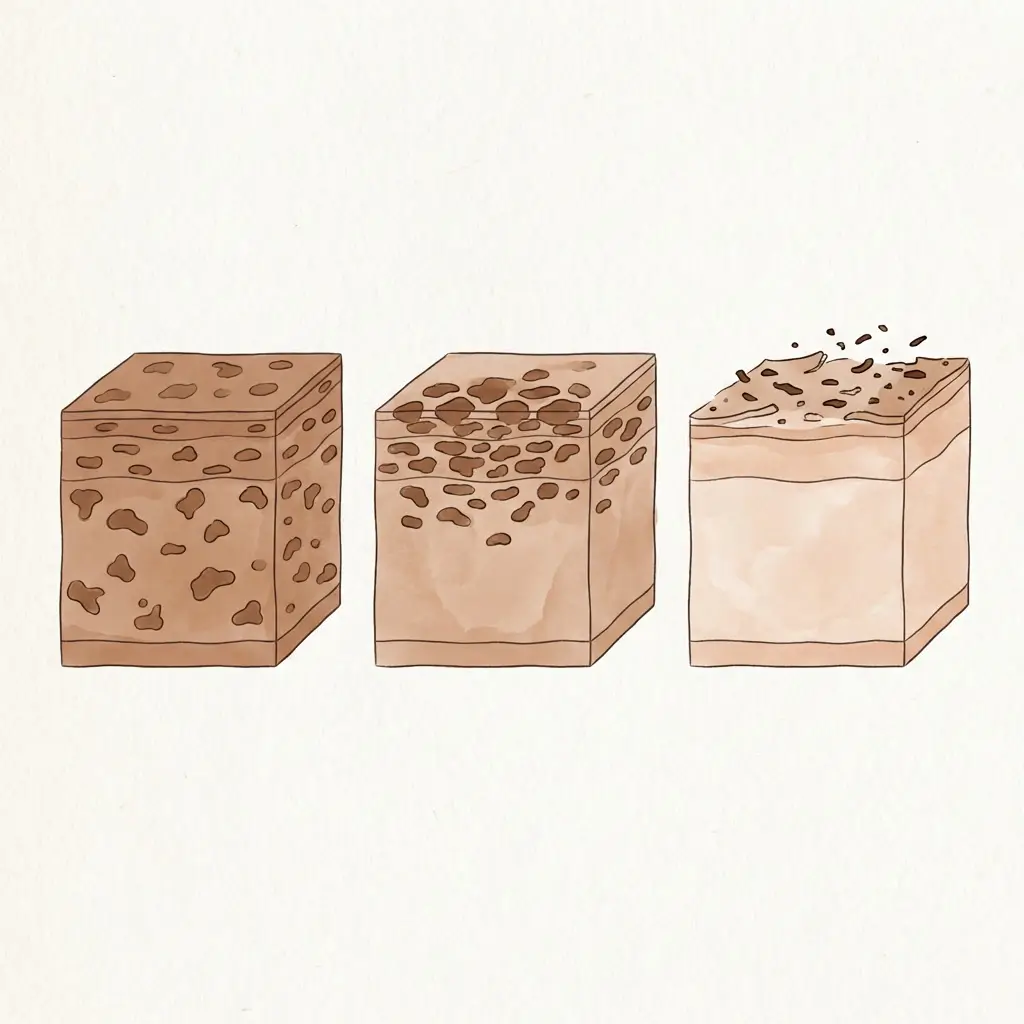
The pigment that was distributed across multiple layers of the epidermis is now concentrated near the surface. It hasn't increased. It has compressed. And compressed pigment looks darker and more defined than pigment spread thinly across a deeper cross-section of skin.
This is the "worse before better" phase. The pigment is surfacing, which is the step that has to happen before it can shed.
Why it looks darker rather than lighter
This confuses people because the expectation is that fading should look like a gradual, even lightening. A slow, smooth transition from dark to light.
That's not how skin turnover works.
Pigment doesn't dissolve in place. It's carried out physically, cell by cell, as the skin sheds. Before those cells shed, they have to reach the surface. And when they reach the surface, they are the outermost layer of your skin, the layer that light hits first and that you see most clearly.
A pigmented cell sitting three or four layers deep is partially obscured by the non-pigmented cells above it. The same cell sitting at the very surface has nothing above it. It's fully exposed. The pigment hasn't changed. Its visibility has.
This is also why treated pigmentation can look more sharply defined during this phase. The edges of a patch become clearer when the pigment is concentrated at the surface rather than diffused through multiple layers. It can genuinely look like the spot has gotten worse when it has actually gotten closer to leaving.
How to tell surfacing from actual worsening
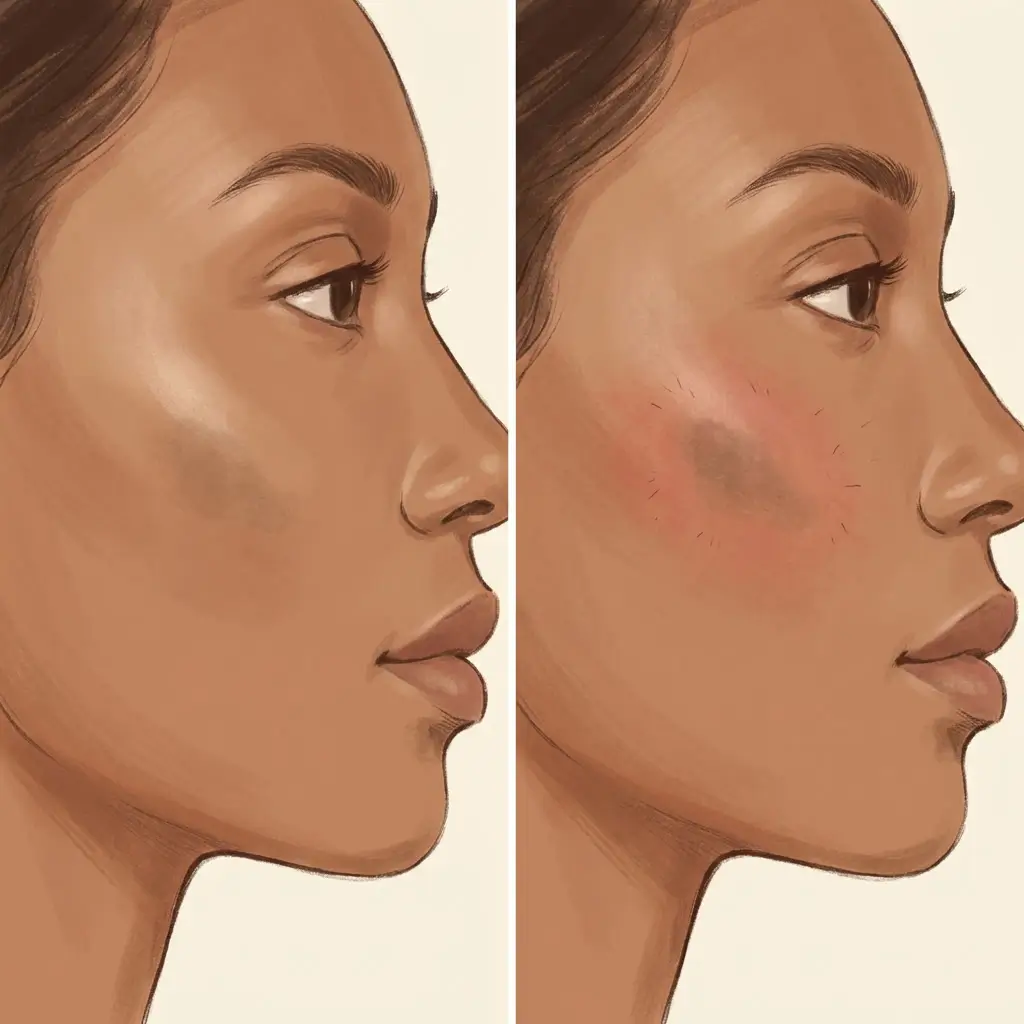
Not all darkening during treatment is benign surfacing. Sometimes treatment genuinely is making things worse, usually because of irritation-driven inflammation reactivating melanocytes. Knowing the difference saves you from either quitting a treatment that's working or persisting with one that's hurting.
Signs that pigment is surfacing normally:
- The darkening appeared a few weeks into a turnover-accelerating treatment (retinoid, AHA, prescription active)
- The skin underneath and around the pigmented area is calm. No redness, no stinging, no persistent irritation
- The texture of the pigmented area may feel slightly rougher or drier, consistent with cells preparing to shed
- The darkening is limited to areas that were already pigmented. No new spots appearing in previously clear skin
Signs that something is actually going wrong:
- Redness, stinging, burning, or tightness that isn't settling. This suggests the treatment is causing inflammation, which can trigger melanocytes to produce new pigment
- New pigmentation appearing in areas that were previously clear. Surfacing only affects pigment that already exists. New spots mean new pigment production
- The darkening is getting progressively worse over weeks without any sign of shedding or lightening beginning. Normal surfacing is a temporary phase, not a trajectory
- Visible barrier damage: peeling that doesn't resolve, persistent dryness, skin that feels raw or sensitised
If you're seeing the second set of signs, the treatment is likely causing irritation that's feeding the pigment cycle rather than clearing it. Scaling back the frequency or strength of the active, or pausing to let the skin recover, is the right move.
How long the surfacing phase lasts
There's no single answer, but there's a reasonable range.
For most people using a retinoid or exfoliating active, the surfacing phase begins around weeks two to four and can last four to eight weeks. During that time, the pigmentation may look worse, look more defined, or seem to stall before it starts visibly clearing.
After that window, if the treatment is working and the skin is tolerating it, you should start to see the pigmented area lighten, soften at the edges, or become less noticeable. The improvement is often gradual and uneven. Some areas clear faster than others. Some spots go through the surfacing phase and shed quickly. Others take longer.
If you're past the eight-week mark with no change and no signs of shedding, it doesn't necessarily mean the treatment has failed. It may mean the pigment is deeper than the epidermis (dermal pigment, which is harder to shift with topicals), or that the treatment strength or type needs adjusting. That's worth discussing with a provider rather than escalating on your own.
Why this matters more for melanin-rich skin
In melanin-rich skin, the surfacing phase tends to be more visually pronounced. There's more melanin in each pigmented cell, so the concentration at the surface produces a more noticeable contrast. The "worse before better" phase looks more dramatic even when it's proceeding normally.
This makes the temptation to stop or escalate stronger. And in melanin-rich skin, both of those reactions carry more risk. Stopping a treatment mid-surfacing means the concentrated pigment at the surface may linger longer without the continued turnover to shed it. Escalating to a stronger active risks tipping into the irritation-driven cycle where the treatment starts creating new pigment.
The best response, if the skin is calm and the darkening fits the surfacing pattern, is to hold steady. Continue the treatment at the current level. Maintain sun protection. Let the turnover cycle complete.
Why the same treatment produces different surfacing phases in different people
Two people can start the same retinoid at the same concentration and have completely different experiences. One notices mild surfacing that resolves in three weeks. The other sees dramatic darkening that lingers for two months.
Part of that is pigment depth and density, which varies by type and skin tone. But part of it is the internal environment the treatment is working against. If background inflammation is elevated, if the body's capacity for inflammatory resolution is depleted, the skin moves through the wound-repair and turnover process less efficiently. The surfacing takes longer. The shedding stalls. And the window where melanocytes might be re-triggered by the treatment's own irritation stays open wider.
The topical is doing its job at the surface. How smoothly the skin processes that work depends in part on what's happening underneath it.
What to take from this
The "worse before better" phase is one of the most common reasons women abandon treatments that were actually working. It feels like failure. It looks like failure. But in most cases, it's the visible evidence of pigment being moved out of the skin, which is exactly what the treatment is supposed to do.
Knowing that this phase exists, knowing what it looks like, and knowing how to distinguish it from genuine worsening is one of the most practically useful things you can understand about pigmentation treatment. It doesn't make the phase less frustrating. But it does give you the information to make a better decision about whether to stay the course or change direction.
The moment it looks worst is often the moment it's closest to turning. The skill is knowing the difference.


